Learn. Explore. Get a Little Nerdy.
You don’t need to be a marine biologist to understand why healthy oceans matter.
Our Educational Resources are designed to make marine science, oyster reefs and coastal restoration easier to understand, whether you’re a student, teacher, parent, community group or simply someone who wants to know more about the world beneath the water.
Start with the basics, follow what interests you, and go as deep as you like. And if you eventually decide that benthic–pelagic coupling sounds exciting rather than terrifying, our Science & Research page is waiting for you.
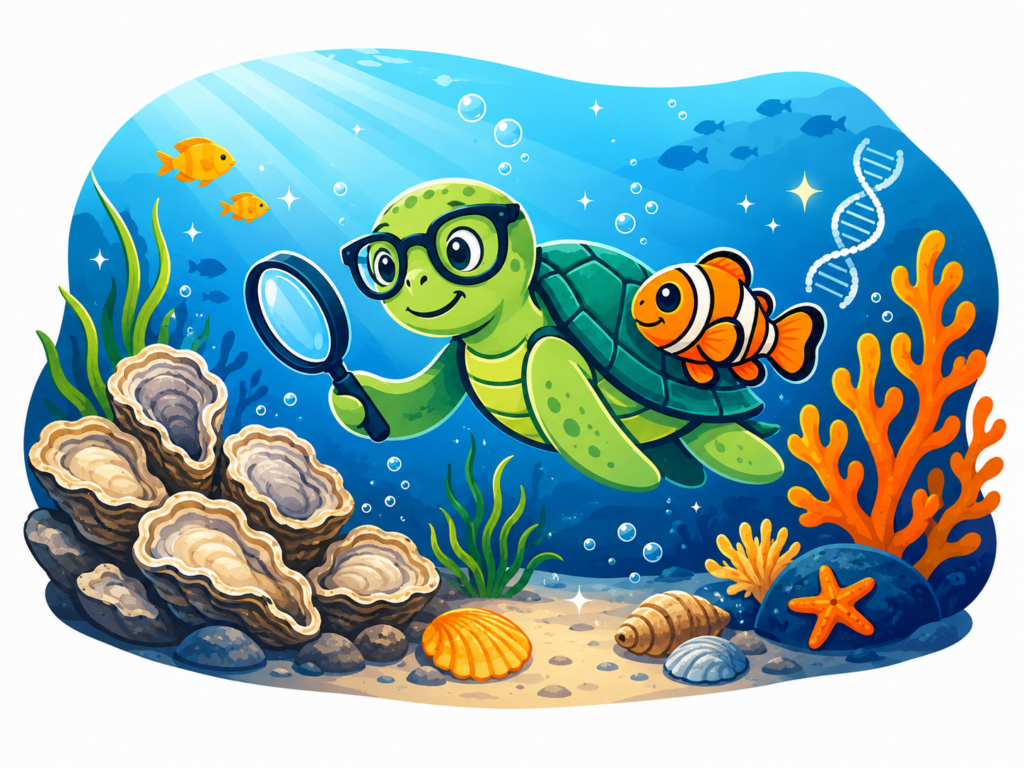
What Is an Oyster Reef?
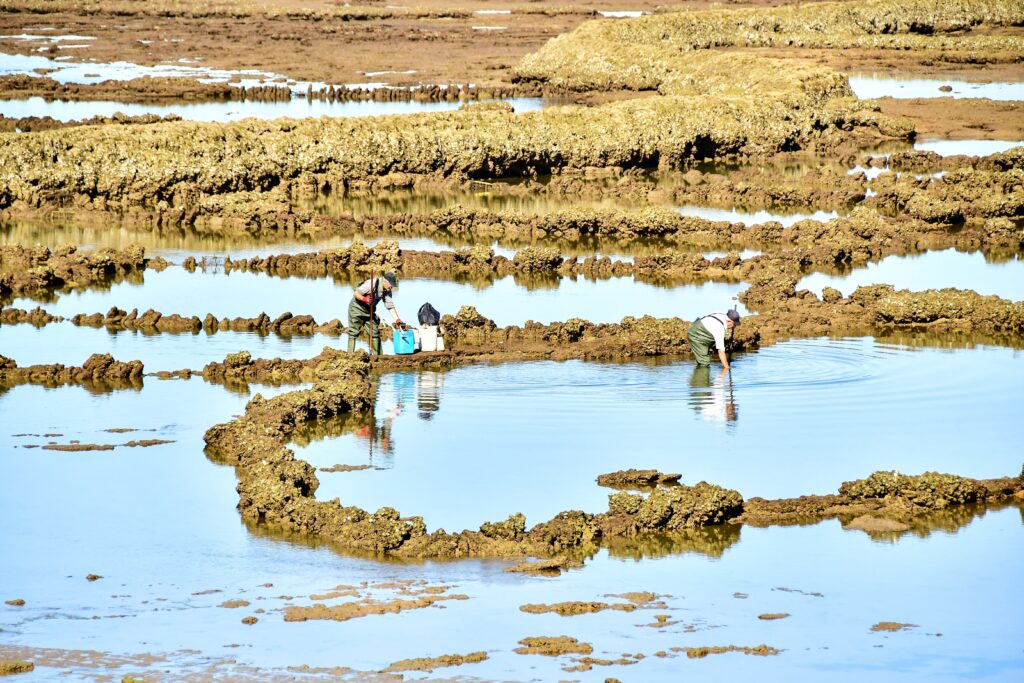
Most people have seen an oyster. Far fewer people have seen an oyster reef.
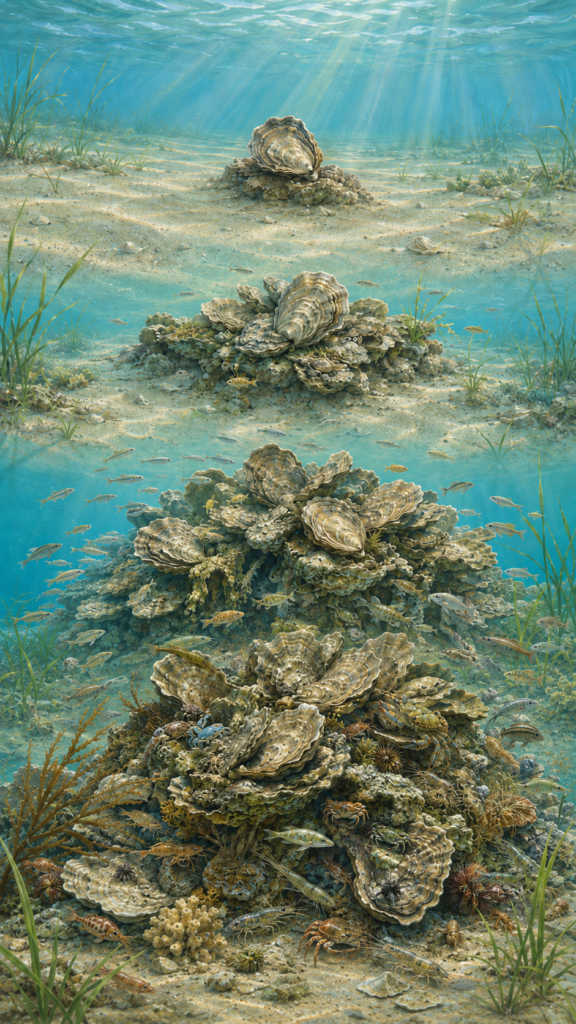
In suitable coastal and estuarine environments, oysters can grow together in dense groups. As new oysters settle onto older shells and the reef builds over generations, a complex three-dimensional habitat can develop.
These reefs can provide shelter and feeding areas for fish, crabs, prawns and many other marine organisms.
They also interact with the water around them as oysters feed and filter suspended particles.
So an oyster reef isn’t simply a pile of oysters. It is a living ecosystem.
Meet the Oyster
Oysters might look simple from the outside, but they are surprisingly specialised animals.
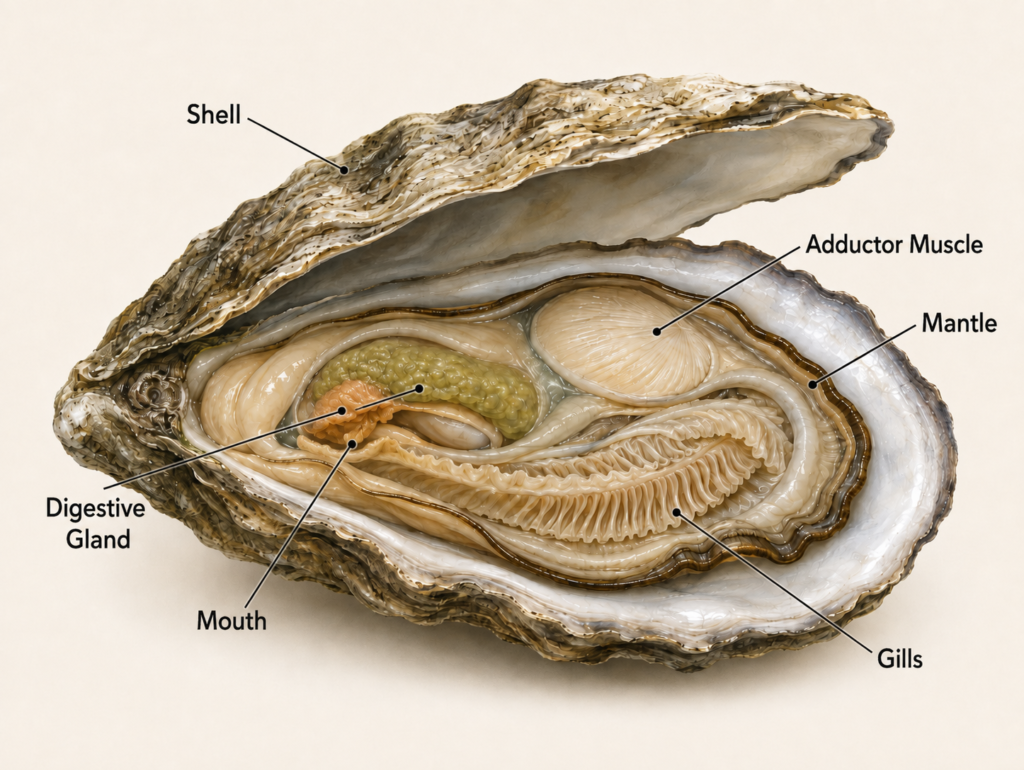
They are bivalve molluscs, meaning their soft body is protected by two shells joined by a hinge. Inside those shells are specialised structures that allow the oyster to feed, breathe, reproduce and respond to changing environmental conditions.
The gills play an especially important role. They are used not only for respiration, but also for feeding. As water moves across the gills, microscopic food particles can be captured and transported toward the mouth.
The mantle lines much of the inside of the shell and helps produce new shell material as the oyster grows, while the powerful adductor muscle allows the oyster to close its shells tightly when conditions are unsuitable or when it is disturbed.
Oysters are therefore much more than passive animals sitting on the seabed. As filter feeders, they are constantly interacting with the water around them.
That means one animal can simultaneously be:
feeding itself, processing the water column and contributing to the ecosystem around it.
How Does an Oyster Eat?
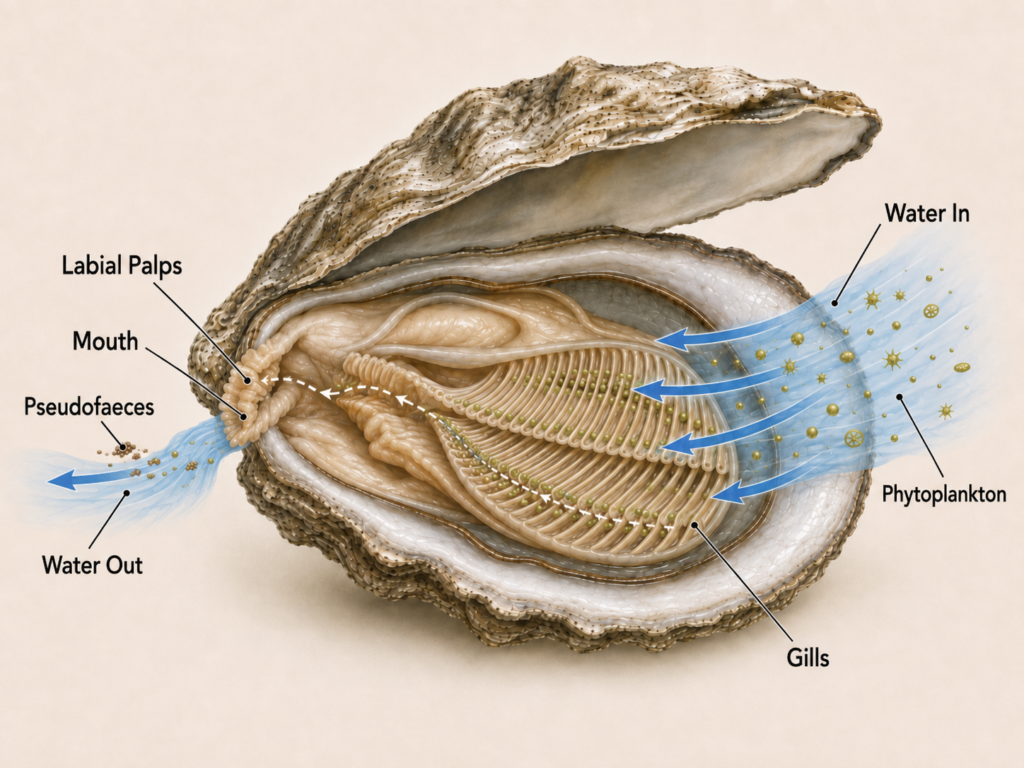
Oysters don’t chase their food. They bring the food to them.
As water moves through the oyster, it passes across the gills. Tiny food particles, especially microscopic algae called phytoplankton, are trapped on the gill surfaces.
Tiny hair-like structures called cilia help move those particles toward the labial palps, which help sort the material. Suitable food is directed toward the mouth, while unwanted particles can be rejected.
The water then returns to the surrounding environment.
Because this process happens continually while an oyster is feeding, large numbers of oysters can interact with a significant amount of the water around them.
Want the much nerdier explanation?
The Oyster Life Cycle
An oyster’s life begins very differently from how it eventually looks on a reef.
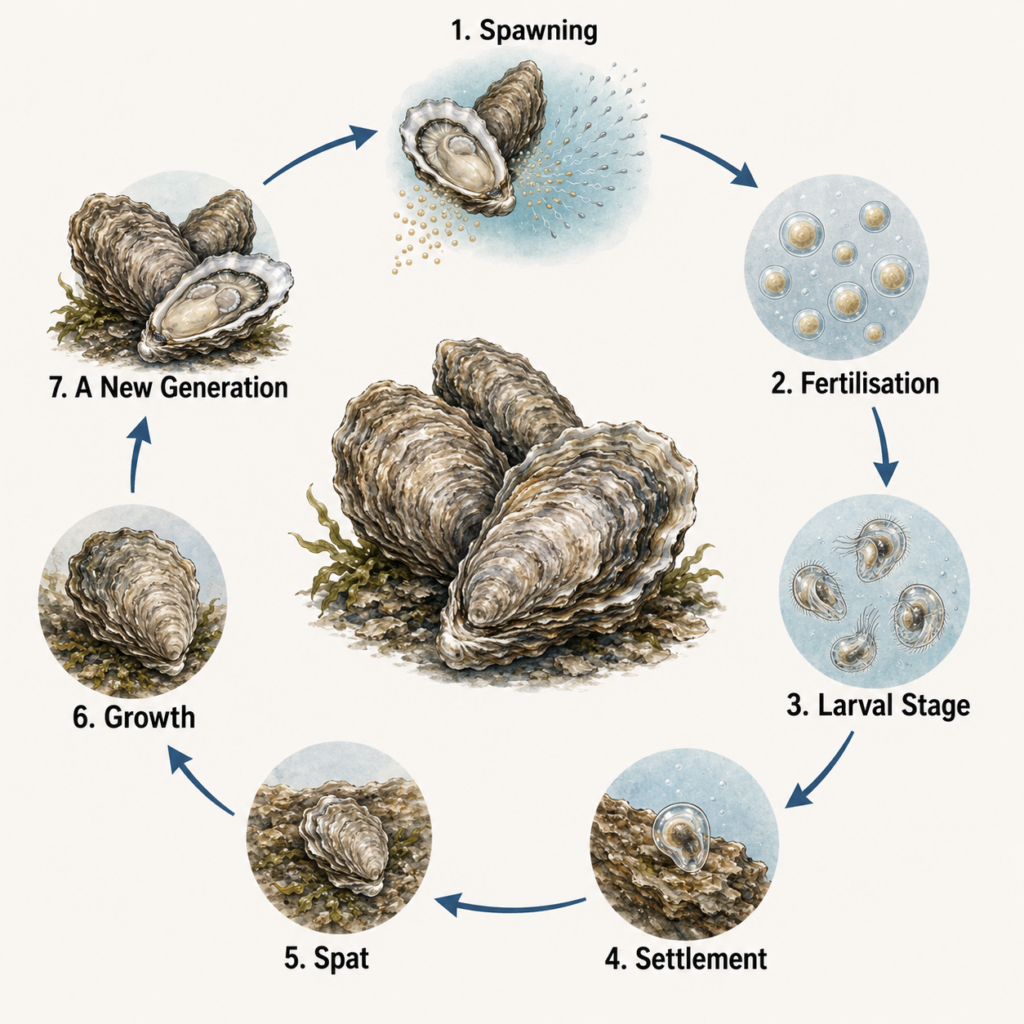
1. Spawning
Adult oysters release eggs and sperm into the surrounding water.
2. Fertilisation
When an egg is successfully fertilised, development begins.
3. Larval Stage
Tiny oyster larvae live within the water column and can be carried by currents.
At this stage, they look very different from adult oysters.
4. Settlement
When a larva is ready to leave the water column, it searches for a suitable hard surface, often existing oyster shell, and attaches permanently.
5. Spat
Once settled, the tiny juvenile oyster is known as spat.
6. Growth
The spat grows, develops a stronger shell and gradually becomes an adult oyster.
7. A New Generation
Mature oysters reproduce, releasing a new generation of larvae into the water.
If some of those larvae successfully settle back onto the reef, the cycle begins again.
Over time, repeated settlement and growth can allow oyster reefs to build upward and outward across generations.
That is why restoring suitable habitat for settlement can be just as important as restoring the oysters themselves.
From One Oyster to an Ecosystem
Habitat begins small
A single oyster provides a small patch of hard habitat. As more oysters settle and grow together, something very different begins to form.
Structure creates shelter
Layers of shell create gaps, crevices and protected spaces where other animals can live. Small crustaceans and invertebrates colonise the reef, juvenile fish use it for shelter, and larger animals arrive to feed.
A reef becomes a community
New oysters continue settling onto older shell, adding even more structure over time. What began as individual oysters can gradually develop into a complex ecological community.
Why this matters
This is one reason oysters are often described as ecosystem engineers, organisms capable of physically changing their environment in ways that create habitat for other species.
How Can Oyster Reefs Help Protect Shorelines?
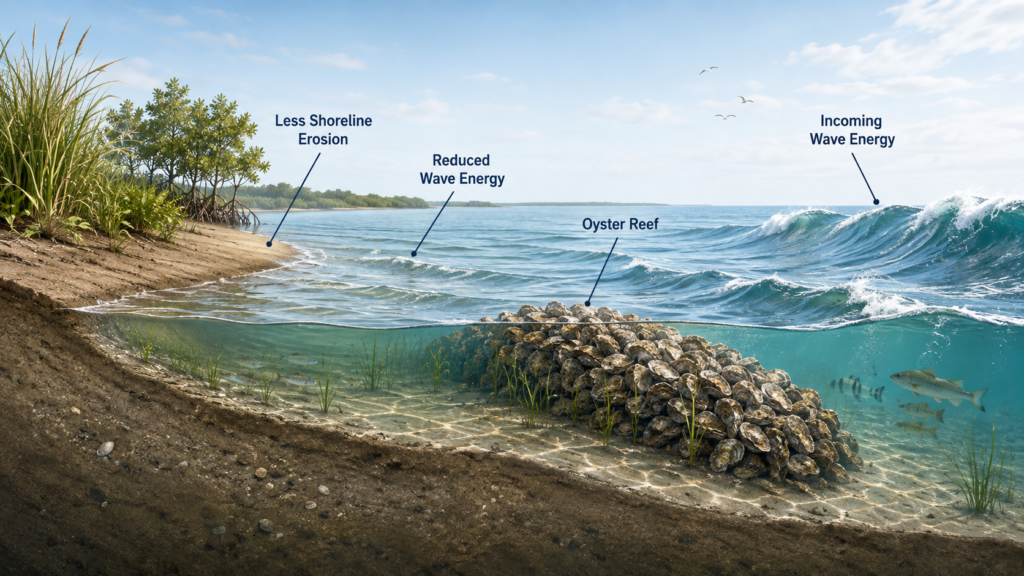
Oyster reefs can also influence the way waves and currents move through shallow coastal waters.
Because a reef creates a raised, rough structure above the seabed, incoming water has to move across and around it. This can reduce some of the energy carried by waves before they reach the shoreline.
By slowing water movement and helping stabilise nearby sediments, well-established oyster reefs can contribute to reduced shoreline erosion in suitable locations.
They can also work alongside other coastal habitats such as mangroves, saltmarsh and seagrass to create a more resilient shoreline.
It is important to remember that oyster reefs do not simply “stop erosion” everywhere. Their effect depends on factors such as reef size, height, water depth, wave conditions, currents and the shape of the coastline.
But in the right environment, they can act as a form of living coastal infrastructure, providing habitat while also helping reduce physical stress on the shoreline.
Everything Is Connected
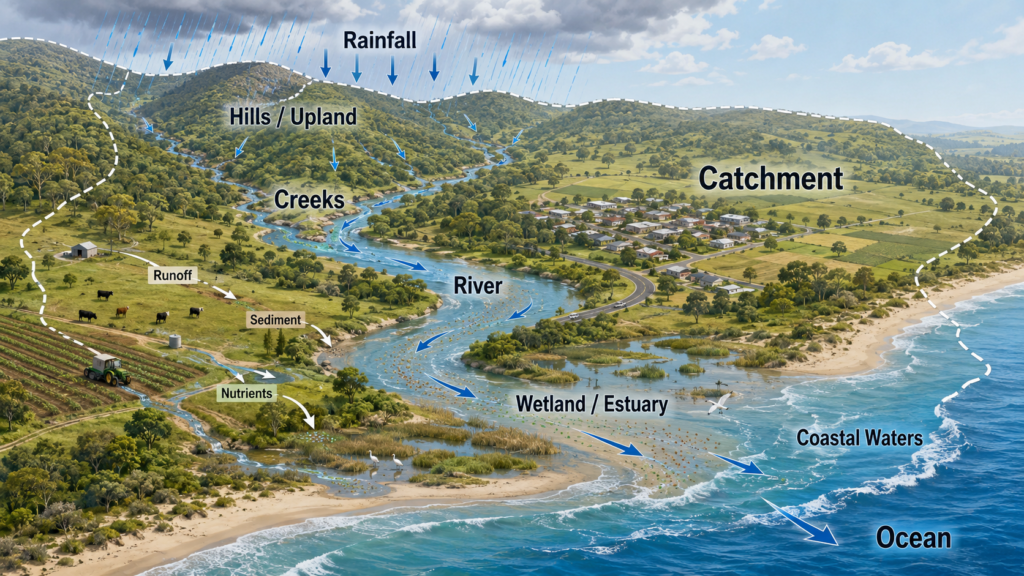
The Great Barrier Reef does not exist separately from the land.
Rain falling across Queensland’s coastal catchments eventually moves through creeks, rivers, wetlands and estuaries before reaching coastal waters.
Along the way, water can carry:
- soil and sediment
- nutrients
- organic matter
- agricultural runoff
- other pollutants
Some sediment and nutrients are completely natural.
Problems arise when the amount entering waterways becomes much greater than the ecosystem would normally experience.
Understanding this connection is important because what happens upstream can influence environments far downstream.
Healthy catchments, wetlands, estuaries, seagrass meadows, oyster reefs and coral reefs are all parts of a connected coastal system.
What Is a Catchment?
A catchment is an area of land where rainfall drains toward the same creek, river, lake or coastal outlet.
Rain follows the shape of the landscape, moving downhill through creeks, rivers and wetlands before eventually reaching the coast.
Along the way, it can carry soil, sediment, nutrients and other materials with it.
Because catchments can cover huge areas, what happens far inland can eventually affect environments much further downstream.
That is why land management, water quality and marine conservation are so closely connected.
What Is Turbidity?
Turbidity describes how cloudy or murky water is because of particles suspended within it.
After heavy rain, rivers often become brown because large amounts of sediment have entered the water.
Very turbid water allows less sunlight to penetrate.
That matters because marine plants such as seagrasses require light for photosynthesis, and corals also depend heavily on light reaching the microscopic algae living within their tissues.
Turbidity naturally changes with tides, weather, currents and seasons.
Scientists therefore monitor it over time rather than judging water quality from a single measurement.
Why Does Seagrass Matter?
Seagrass is not seaweed.
It is a true flowering plant that has adapted to living underwater.
Seagrass meadows can provide important habitat and nursery areas for fish and invertebrates and are an important food source for animals including dugongs and green turtles.
Like plants on land, seagrasses need sufficient light for photosynthesis.
If water remains highly turbid for extended periods, less light reaches the seabed and seagrass can struggle to grow.
This is one reason water clarity is an important part of coastal ecosystem health.
What Does Biodiversity Mean?
Biodiversity simply means the variety of living things.
That can include diversity between:
species, meaning different types of animals, plants and microorganisms;
genes, meaning variation within individual species;
ecosystems, meaning different habitats and ecological communities.
A healthy oyster reef is not valuable because oysters exist there alone.
Its value comes partly from the much larger community of organisms that the reef can support.
What Is Restoration?
Conservation and restoration are related, but they are not exactly the same.
Conservation often focuses on protecting ecosystems that still exist.
Restoration focuses on helping damaged or lost ecosystems recover.
Sometimes nature can recover once a pressure is removed.
In other situations, important parts of the original habitat have disappeared and active intervention may be required.
For oyster reefs, that can mean rebuilding hard reef foundation, introducing native juvenile oysters and restoring the conditions needed for future generations to establish naturally.
The long-term goal is not permanent human intervention.
It is helping the ecosystem reach a point where natural processes increasingly take over again.
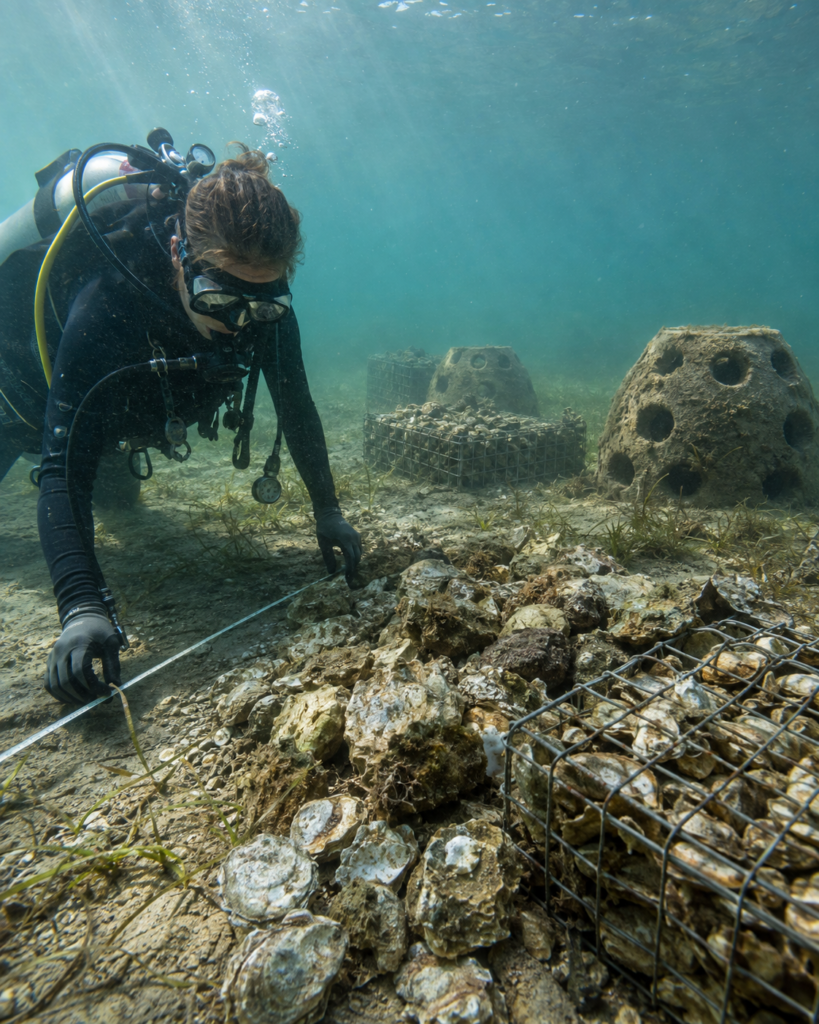
How Do Scientists Know if Restoration Is Working?

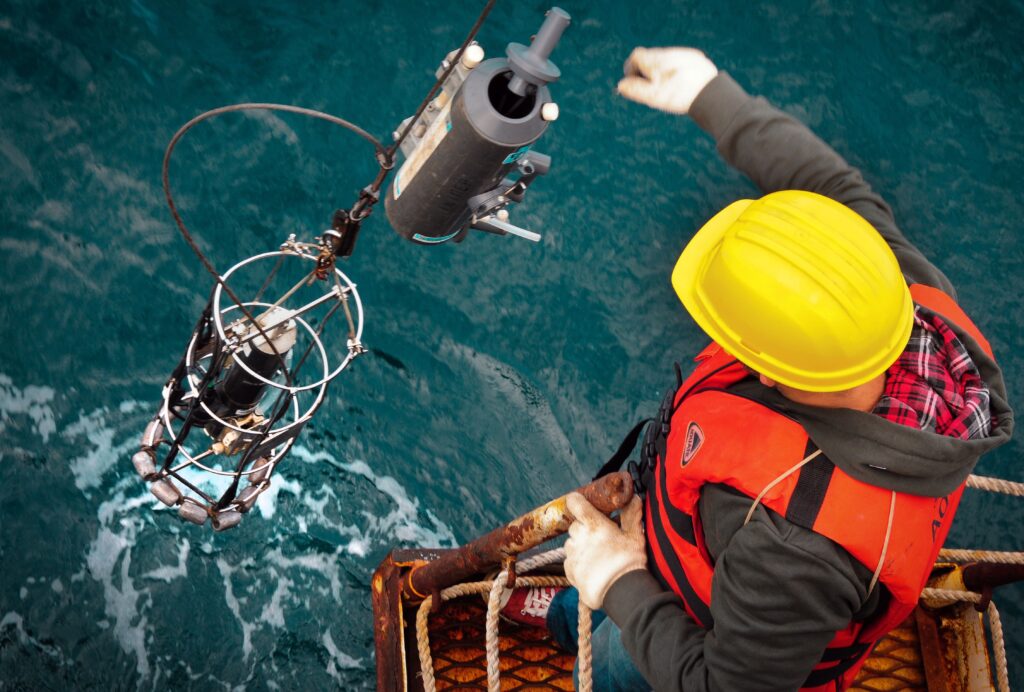
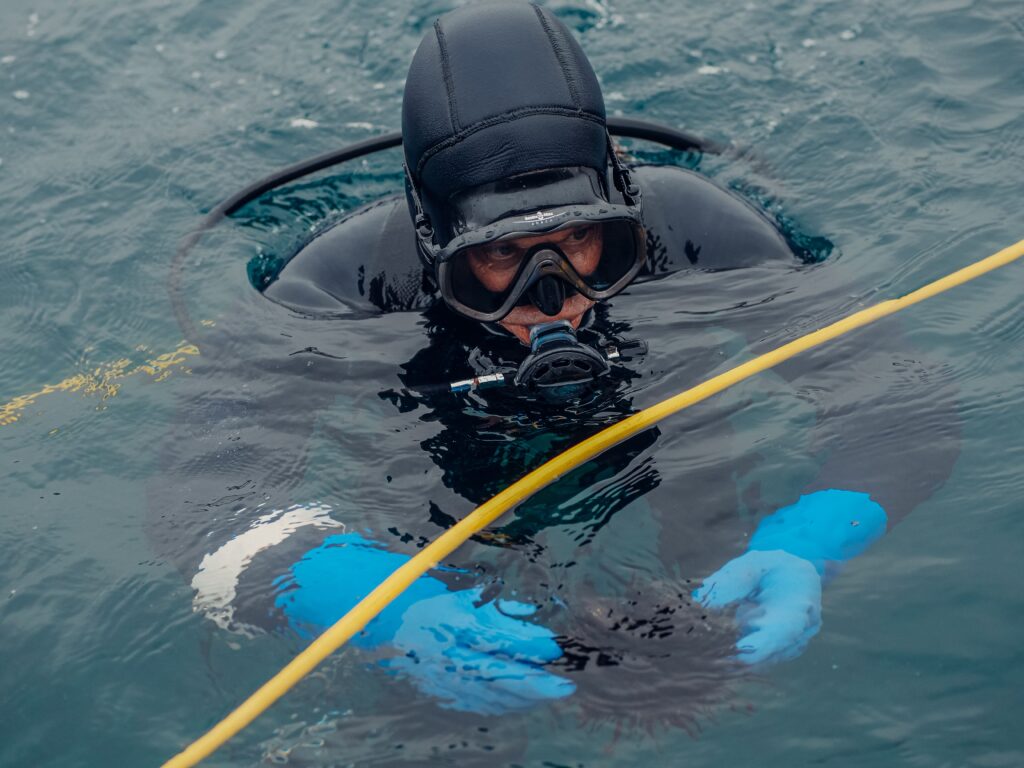
Scientists measure what happens.
Before restoration begins, researchers may collect baseline data describing the existing environment.
After restoration, the same things can be measured again.
This might include:
- oyster survival
- oyster growth
- new oyster settlement
- fish abundance
- invertebrate diversity
- water temperature
- salinity
- turbidity
- dissolved oxygen
- nutrients
- seagrass condition
- changes in reef structure
Where possible, scientists may also compare restored areas with similar locations that have not been restored.
This helps answer an important question:
Did the restoration cause the change, or was something else happening in the environment?
For the technical version of how this monitoring works, visit our:
A Few Words You Might Hear Around Here
A young oyster that has completed its swimming larval stage and permanently attached to a surface.
Adult oysters used to produce the next generation of larvae in a hatchery.
The surface or material on which an organism lives or attaches. In oyster restoration this can include shell, rock or other suitable reef material.
An environment where freshwater flowing from rivers mixes with seawater.
A measure related to the amount of suspended material making water appear cloudy or murky.
The amount of dissolved salt in water.
The process by which new individuals successfully join a population. For oyster reefs, this often means young oysters settling and surviving on the reef.
Material filtered from the water by organisms such as oysters and later deposited toward the seabed as faeces or rejected particles.
A microbial process in which biologically available nitrogen is ultimately converted into nitrogen gas.
The study of how water moves.
An organism that changes its physical environment in ways that affect other species. Oyster reefs are a good example.
Resources for Schools & Teachers
We are developing educational material to help students and teachers explore marine ecosystems, water quality, oyster biology and environmental restoration.
Explore Further
If you’ve reached this point and want more detail, we’ve got you covered.
How We Restore Oyster Reefs
Want to understand how reef foundations, hatcheries, juvenile oysters, shell recycling and deployment actually fit together?
Ready for the Nerdy Stuff?
Want to get into filtration physiology, nitrogen cycling, hydrodynamics, sediment processes and restoration monitoring?
What’s Happening on the Reef?
Follow current research, environmental developments and stories from around the Great Barrier Reef.
Keep Learning
The ocean is an enormously complex system, and no single page can explain all of it.
Our goal is to continue building this resource library as The Nautical Nerds grows, adding new explainers, activities, diagrams, videos and learning materials that help more people understand the ecosystems we are working to restore.
Because the more we understand about how these systems work, the better equipped we are to look after them.
Ahoy! Professor Shell here. Ask me about The Nautical Nerds, oyster reefs, marine science or our oceans.