Ready to Get a Little Nerdy?
So far, we’ve kept things fairly simple. Oyster reefs filter water, create habitat and help support healthier coastal ecosystems.
But how does an oyster actually filter water? Where do the sediments and nutrients go? What role do bacteria play? Why does water flow matter? And how do we know whether a restored reef is actually working?
This is where we get into the science behind it all.
Fair warning: things get a little technical from here. If terms like benthic–pelagic coupling, biodeposition, denitrification and hydrodynamics aren’t your thing, you may prefer our Educational Resources page for the easier version.
But if you want to understand what is actually happening inside an oyster reef, from the movement of microscopic particles through an oyster’s gills to the chemistry occurring in the sediment beneath a reef, you’re in the right place.
Welcome to the nerdy part.
The Science Behind Living Reef Restoration
Marine restoration is most effective when it is built on an understanding of how ecosystems function, not simply on replacing what has been lost.
Oyster reefs are more than aggregations of shellfish. They are biogenic habitats created by living organisms, capable of modifying the physical, chemical and biological environment around them. As oysters settle, grow and accumulate over generations, they form complex three-dimensional structures that interact with the water column, seabed, microorganisms and surrounding marine community.
The science behind oyster reef restoration therefore extends well beyond oyster survival. It includes filtration physiology, sediment dynamics, nutrient cycling, microbial processes, hydrodynamics, larval recruitment, habitat complexity and the response of entire ecological communities.
For The Nautical Nerds, understanding these processes is fundamental to deciding where restoration is appropriate, how reefs should be designed, what should be measured and whether restoration is actually delivering ecological improvement.
These principles are supported by decades of international restoration experience and a growing body of Australian research. Our role is to apply that knowledge carefully to tropical Queensland conditions and measure what happens in the field.
OYSTER BIOLOGY
Oyster Reefs as Ecosystem Engineers
Ecologists use the term ecosystem engineer to describe an organism that physically modifies its environment in ways that create or change habitat for other species.
Oysters are particularly powerful ecosystem engineers because their shells persist and accumulate.
A single oyster provides a hard surface. Thousands of oysters settling upon one another can produce a reef with vertical relief, crevices, cavities and complex edges. Over time, this structure alters local water movement, provides attachment surfaces for other organisms and creates refuge from predators.
The ecological effect therefore comes from two interconnected components:
LIVING OYSTERS
Filter water, process nutrients and suspended particles, and support reef productivity.
REEF STRUCTURE
Creates habitat, alters water movement and sediment conditions, and supports marine life.
Research on tropical oyster reefs shows that reef-building oysters can provide many of the same broad ecosystem functions documented in temperate systems, while also differing in important ways. Tropical reef-forming oysters tend to grow faster, may recruit for longer periods of the year and occur as more diverse mixed-species assemblages than many temperate reefs. At the same time, tropical oyster reef ecology remains substantially less studied, making careful monitoring particularly important when restoration is undertaken in northern Australia.
SPECIES FOCUS
The Blacklip Rock Oyster
The Blacklip Rock Oyster (Saccostrea echinata / Saccostrea spathulata) is a native tropical rock oyster found in northern Australian waters and is of particular interest for restoration because of its ability to function under warm, highly variable estuarine conditions.
Blacklip oysters naturally experience environmental fluctuations very different from many temperate oyster species commonly used in international restoration programs. Tropical river mouths can undergo rapid changes in temperature, salinity, suspended sediment and freshwater input, particularly during northern Australia’s wet season.
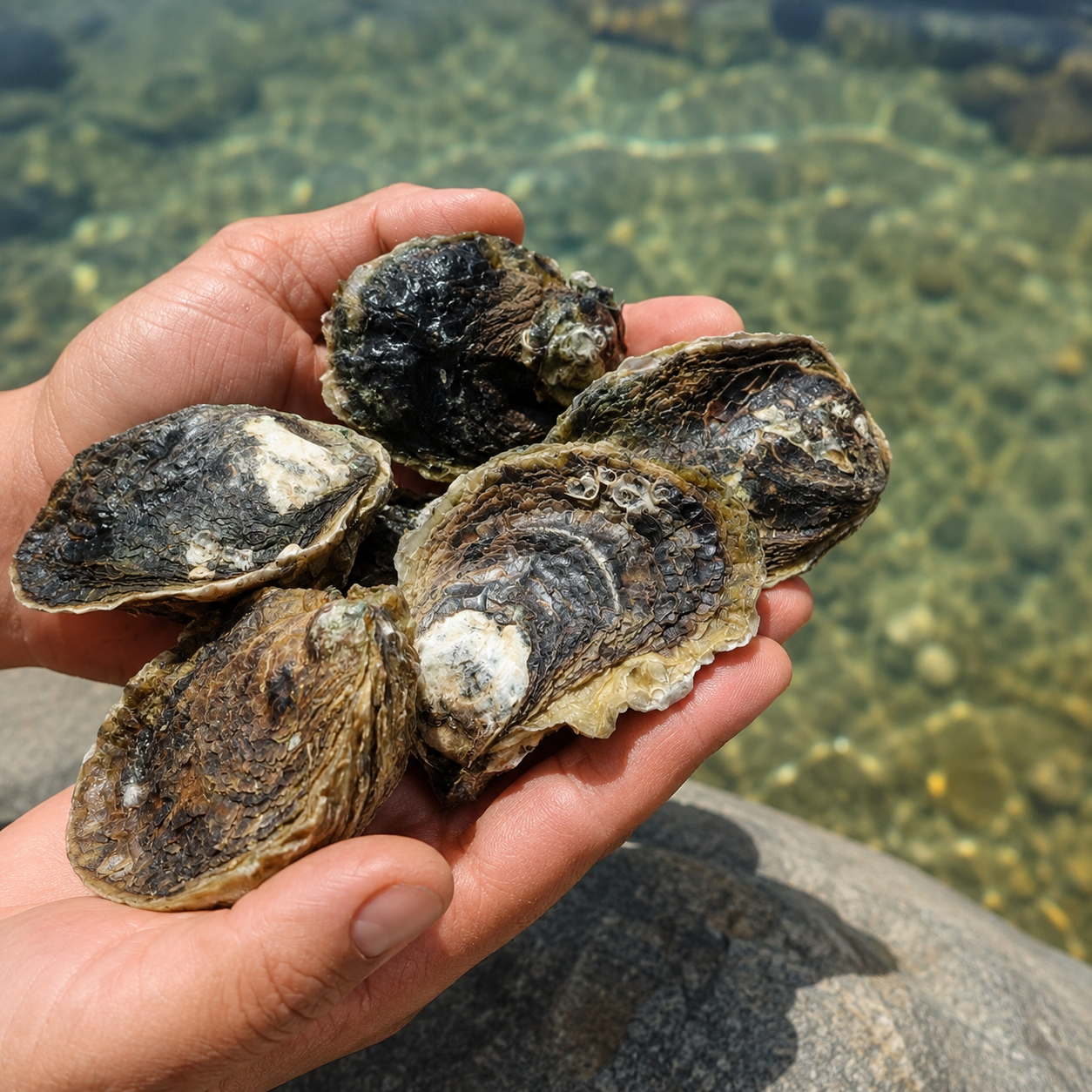
BLACKLIP ROCK OYSTER
Native tropical reef-forming oyster
Northern Australia · Tropical estuarine species
WARM-WATER FILTRATION
24–32°C
Blacklip Rock Oysters showed particularly strong filtration performance across this warm-water range in laboratory experiments.
Rennie et al. (2024)
LARVAL DEVELOPMENT
20–25 DAYS
Earlier northern Queensland hatchery research observed larval settlement approximately 20–25 days after fertilisation under experimental culture conditions.
Northern Queensland hatchery research
TAXONOMY NOTE
Why the scientific name varies
The taxonomy of tropical Australian Saccostrea oysters has undergone significant revision as genetic methods have improved.
The Blacklip Rock Oyster has historically been referred to as Saccostrea echinata in Australian research and government literature. Molecular studies have also referred to the relevant Blacklip oyster as Saccostrea lineage J, with recent genetic work proposing identification as Saccostrea spathulata. Other current research continues to use S. echinata.
For clarity, we use the common name Blacklip Rock Oyster throughout this page and identify the scientific nomenclature used by individual studies where relevant.
FILTRATION PHYSIOLOGY
How Oyster Filtration Actually Works
Oysters are suspension-feeding bivalves.
They do not clean water in the same way that a mechanical filter does. Instead, filtration is a biological process driven largely by the gills.
Water is moved through the mantle cavity and across highly specialised gill surfaces. Microscopic particles suspended in the water encounter mucus-covered structures on the gills, where cilia help capture, sort and transport material.
Particles suitable for consumption can be directed toward the mouth. These include phytoplankton and other suspended organic material.
Material captured by the gills but rejected before ingestion may be packaged into pseudofaeces and expelled. Material that is consumed is digested, with unassimilated material later released as faeces.
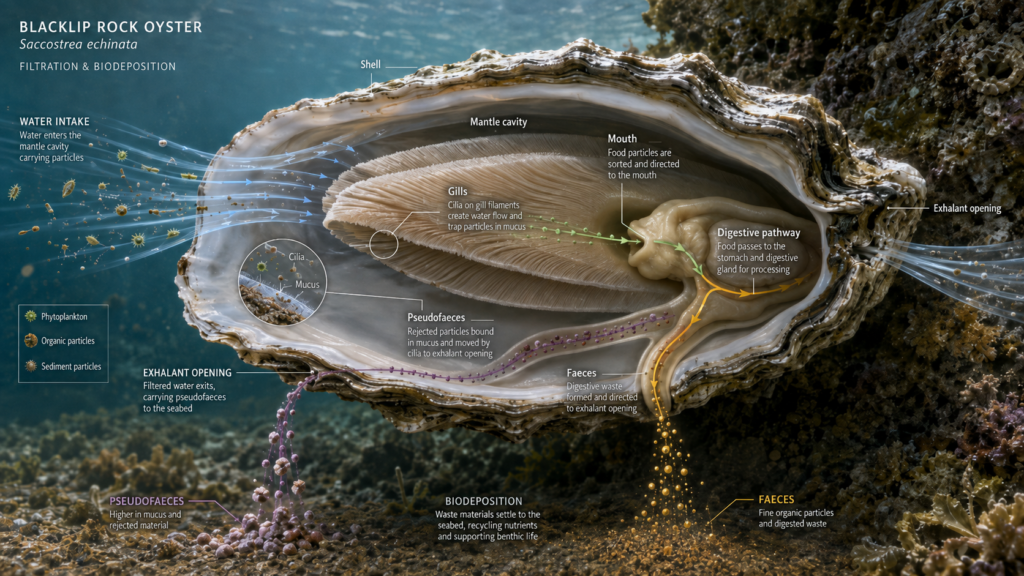
Oysters do not simply make suspended matter disappear.
They intercept, process, transform and redistribute it.
FILTRATION RATE
Filtration Rate Is Not a Fixed Number
The amount of water processed by an oyster can change considerably depending on environmental and biological conditions.
Temperature, salinity, food availability, suspended particle concentration, water movement, oyster size and physiological condition can all influence feeding behaviour and filtration.
This is why statements such as “an oyster filters 200 litres of water every day” should be treated cautiously unless the species, oyster size and environmental conditions are defined.
In the 2024 Blacklip Rock Oyster study, filtration rates between 24°C and 32°C were approximately 12.68–15.20 litres per hour per gram of oyster tissue. Those measurements demonstrate strong filtration potential in warm conditions, but they should not be converted into a universal litres-per-oyster claim without accounting for oyster biomass and field conditions.
SCIENCE NOTE
Filtration rates should be measured under defined conditions, not turned into one universal litres-per-oyster claim.
FILTRATION EFFECTS
What Filtration Can Remove From Suspension
Oyster feeding can influence several components of the water column.
In a controlled experiment using prawn-farm effluent, higher densities of Blacklip Rock Oysters significantly reduced measured total suspended solids, chlorophyll-a, total nitrogen and total phosphorus over a three-hour experimental period.
TOTAL SUSPENDED SOLIDS
~95% ↓
reduction
CHLOROPHYLL-A
29% ↓
reduction
TOTAL NITROGEN
13% ↓
reduction
TOTAL PHOSPHORUS
16% ↓
reduction
Highest experimental stocking density · three-hour controlled trial · relative to controls without oysters
A controlled tank experiment is not an open river mouth.
In an estuary, water is continually moving. River discharge, tides, waves, residence time, oyster density, sediment resuspension, nutrient concentrations and the volume of water passing through a reef all influence the magnitude of any measurable effect.
Our interest is therefore not in assuming that laboratory percentage reductions will occur in the field, but in using the underlying biological evidence to inform restoration and then measuring what occurs under real tropical estuarine conditions.
ECOSYSTEM PROCESSES
Benthic–Pelagic Coupling
One of the more important concepts in oyster reef ecology is benthic–pelagic coupling.
The term describes the connection between the pelagic environment, or water column, and the benthic environment, which includes the seabed and sediments below.
Oysters sit directly at that interface.
Suspended organic particles and phytoplankton that would otherwise remain in the water column can be intercepted by oysters. Some material is incorporated into oyster biomass, while other material is deposited toward the seabed as faeces or pseudofaeces.
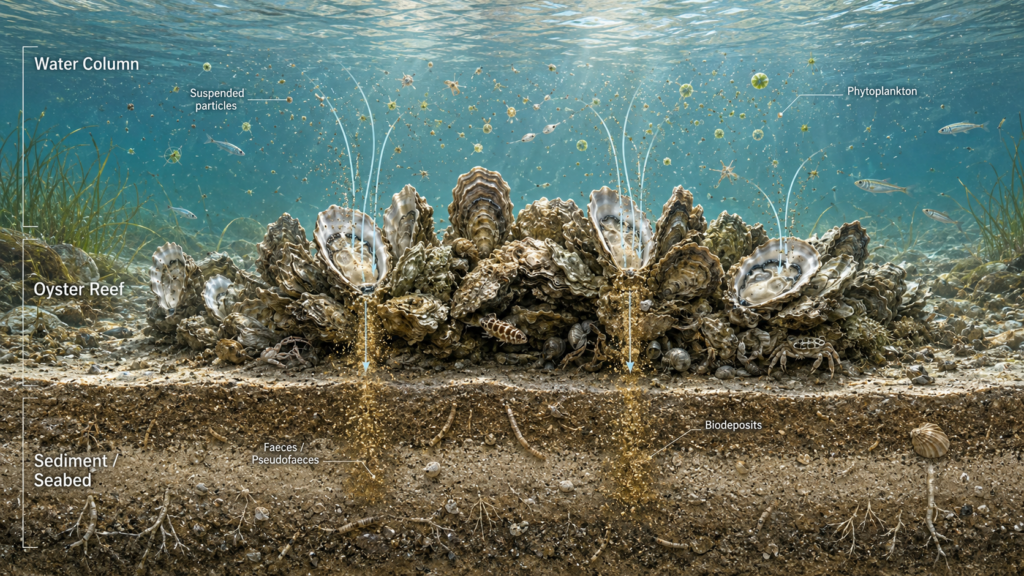
These deposits are collectively known as biodeposits.
By transferring material between the water column and sediment, dense populations of suspension feeders can alter nutrient availability, sediment microbial activity, organic matter processing and local oxygen demand.
This means an oyster reef does not simply affect what is happening above the reef. It can also change biological and chemical processes occurring inside and immediately beneath the reef sediments.
KEY IDEA
Oyster reefs connect the water column above with the sediment processes below.
MATERIAL FATE
Biodeposition: The Material Does Not Vanish
Biodeposition is one reason oyster filtration needs to be understood as an ecological process rather than simply described as “cleaning water”.
Some captured particles are consumed and incorporated into the oyster.
Others eventually become faeces.
Particles rejected before consumption become pseudofaeces.
Both can settle onto or around the reef.
This may reduce the amount of material remaining suspended in the water column, but it also increases the transfer of organic material to the benthos.
WELL-FLUSHED CONDITIONS
Biodeposits can support microbial nutrient processing and benthic food webs when water movement and oxygen exchange are sufficient.
POORLY FLUSHED CONDITIONS
Where circulation is weak and organic loading is high, excessive deposition can increase sediment oxygen demand and create undesirable conditions.
Reviews of shellfish bioremediation emphasise that oyster effects are context dependent. Sediment type, temperature, water movement, reef density, season and other environmental conditions can influence the direction and magnitude of the response.
The right oyster reef in the right place matters more than simply maximising oyster numbers.
NUTRIENT DYNAMICS
Nitrogen Cycling
Nitrogen is essential for biological productivity, but excess biologically available nitrogen can alter coastal ecosystems.
Elevated nutrient loads can stimulate phytoplankton and algal growth and contribute to ecological changes associated with eutrophication.
For the Great Barrier Reef, the scientific consensus is clear that catchment pollutant loads remain above pre-development levels and that elevated nutrients, fine sediments and other pollutants particularly affect freshwater, estuarine, coastal and inshore ecosystems. Good water quality also supports the capacity of these systems to recover from disturbances.
Oyster reefs can influence nitrogen through several different pathways.
ASSIMILATION
This represents storage rather than necessarily permanent removal. In an unharvested restoration reef, some nitrogen may eventually return to the system following oyster death and decomposition.
BIODEPOSITION
This can make nitrogen more available to sediment microbial communities and influence the way nutrients are processed around the reef.
BURIAL
Burial can store nitrogen for longer periods, although the amount retained will depend on local sediment conditions, water movement, organic loading and disturbance.
DENITRIFICATION
Oysters do not perform denitrification themselves. Instead, oyster reefs can create conditions that support the microorganisms responsible for it by increasing organic matter delivery to sediments and altering the environment around the reef.
When N₂ is released from the aquatic environment, that nitrogen has effectively been removed from the biologically available nutrient pool.
DENITRIFICATION IN MORE DETAIL
How Nitrogen Leaves the Aquatic System
Within suitable low-oxygen sediment environments, microorganisms can convert reactive nitrogen compounds through a series of biochemical transformations, ultimately producing dinitrogen gas, N₂.
N₂ is the chemically stable form that makes up approximately 78% of Earth’s atmosphere. When reactive nitrogen is converted to N₂ and released from the aquatic environment, that nitrogen has effectively been removed from the biologically available nutrient pool.
Oyster reefs can influence this pathway by increasing organic matter delivery to sediments and creating surfaces and microenvironments that support microbial communities.
However, studies have found very large differences in oyster-associated denitrification between sites. Some reefs show substantial enhancement, while others show far smaller effects. Temperature, sediment conditions, organic matter, hydrodynamics and reef characteristics all influence the result.
Nitrogen removal should be measured, not assumed.
SEDIMENT & WATER QUALITY
Sediment, Turbidity and Light
Sediment is a natural component of tropical coastal environments.
The ecological problem is not the existence of sediment itself, but changes in the amount, particle size, duration of exposure, resuspension and deposition experienced by marine ecosystems.
Fine particles such as silt and clay can remain suspended for long periods and may be transported considerable distances from river mouths.
01
FINE SEDIMENT
Silt and clay remain suspended in the water column.
02
TURBIDITY RISES
More suspended particles make the water increasingly cloudy.
03
LIGHT DECLINES
Less sunlight can penetrate through the water column.
04
ECOSYSTEM STRESS
Corals and seagrasses receive less light for photosynthesis.
That matters because seagrasses and the symbiotic microalgae associated with reef-building corals depend on sufficient light for photosynthesis.
AIMS reports that modelling indicates fine-sediment loads delivered to the Great Barrier Reef are now approximately three to eight times estimated pre-development loads. Excessive sediment and turbidity can reduce light, interfere with coral settlement and growth, affect fish behaviour and reduce the capacity of corals and seagrasses to recover from other disturbances.
SEDIMENT FATE
What can oyster filtration actually do with sediment?
INTERCEPT
Oyster filtration can intercept some fine suspended material.
REPACKAGE
The sediment is not destroyed. Filtration changes how particles are packaged, transported and deposited.
FATE MATTERS
Material may be stabilised, buried, resuspended or accumulated somewhere undesirable, so its eventual fate must be considered when assessing a restoration reef.
Filtration changes the fate of sediment. It does not make sediment disappear.
SITE SELECTION
Hydrodynamics: The Science of Where a Reef Belongs
Restoration site selection is partly a biological question and partly a problem in hydrodynamics, the science of water in motion.
Water movement determines how quickly food, oxygen, suspended material and larvae are delivered to an oyster reef.
It also determines whether biodeposits disperse, whether sediment accumulates, whether reef material is scoured and whether structures remain stable during extreme flows.
TOO LITTLE FLOW
Poor Exchange
Food and oxygen delivery may be limited, while biodeposits and organic material can accumulate around the reef.
SUITABLE FLOW
Effective Exchange
Water movement can deliver food and oxygen while allowing waste products and suspended material to disperse.
TOO MUCH FLOW
Physical Stress
Strong currents can increase scour, destabilise restoration materials and expose oysters to excessive physical stress.
The goal is not the calmest water or the strongest current. It is the right amount of exchange.
In tropical Queensland, this becomes especially complex because river mouths can experience large seasonal changes in freshwater flow, salinity, sediment concentration and current velocity, together with extreme events such as floods and tropical cyclones.
Bathymetry, tidal exchange, current direction and velocity, substrate type, freshwater influence, sediment transport, navigation constraints and existing sensitive habitat can all form part of a scientifically defensible site-assessment process.
HABITAT & BIODIVERSITY
Habitat Complexity and Biodiversity
Filtration is only one reason to restore oyster reefs.
A second major ecological function is habitat creation.
Flat sand and mud environments can contain highly diverse biological communities, but they provide a very different physical environment from a structurally complex reef.
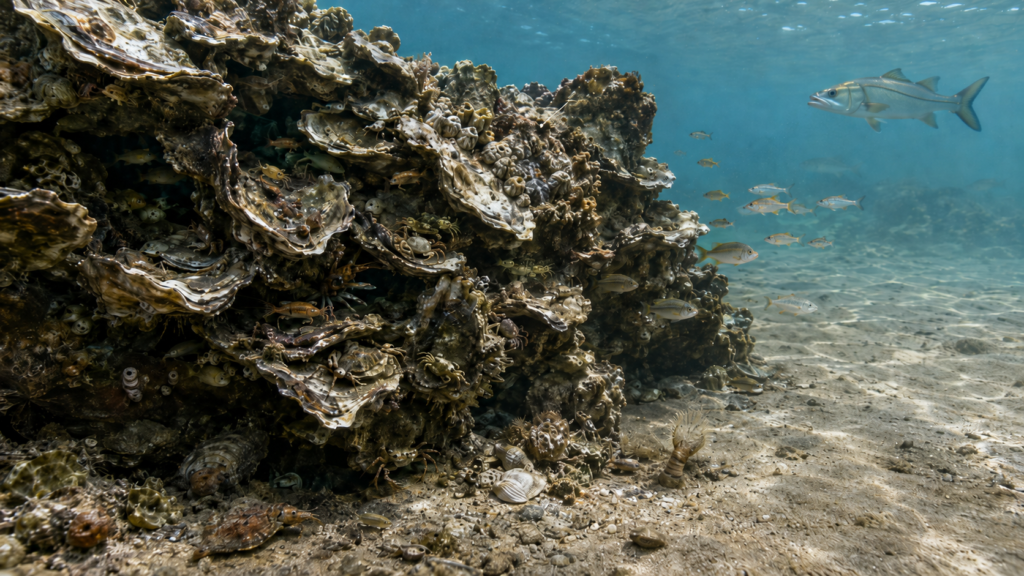
Oyster reefs introduce hard substrate and three-dimensional relief.
REFUGE
Crevices between shells can provide shelter for juvenile fish, small crustaceans and other animals seeking protection from predators.
FEEDING
Reef edges and surfaces create feeding opportunities for fishes and invertebrates moving through the surrounding habitat.
ATTACHMENT SURFACES
Hard oyster shells provide surfaces for sessile organisms to attach and grow, increasing the biological complexity of the reef.
FOOD-WEB SUPPORT
As more organisms colonise the reef, they can themselves become food for larger predators, linking oyster reefs to wider estuarine food webs.
Research on oyster restoration has consistently found that reef structure and complexity can affect recruitment, refuge availability, associated biodiversity and the ecological services produced by a restored reef.
The objective is therefore not simply to establish a high density of oysters. A mature restoration reef should increasingly demonstrate the characteristics of a functioning ecological community.
A restored oyster reef is not just shellfish. It is habitat.
REEF DEVELOPMENT
From Spat to a Self-Sustaining Reef
Oyster reef restoration ultimately depends on successful reproduction and recruitment.
Adult oysters release gametes into the water, where fertilisation occurs. The resulting larvae develop within the plankton before becoming ready to settle.
Once a suitable hard substrate is found, the larva permanently attaches and begins its benthic life as a juvenile oyster, commonly known as spat.
From Larvae to Living Reef
THE MISSING FOUNDATION
Hard Substrate Is Critical
When an oyster reef is lost, the oysters are not the only thing that disappears. The accumulated shell structure that once provided hard settlement surface can be lost as well.
Historical harvesting, dredging, shell removal and coastal modification have removed or degraded many shellfish reefs. In places now dominated by soft or unstable sediment, oyster larvae may still be present in the water but have very little suitable surface on which to settle.
Shell is particularly valuable because oysters naturally settle on existing shell. New oysters add more shell, creating additional settlement surface and allowing the reef to build over time.
Restoration can therefore mean rebuilding the physical foundation that allows natural recruitment to begin again.
A successful restoration reef should become progressively less dependent on repeated stocking
REEF DESIGN
Why Reef Elevation Matters
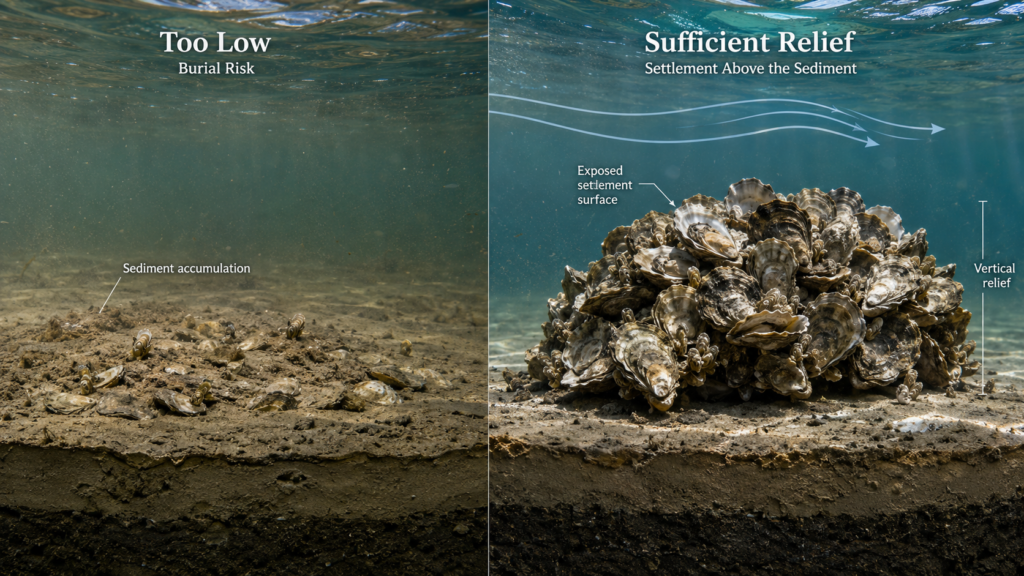
Vertical relief can be just as important as the total area of a restored reef.
A reef sitting above the surrounding seabed can experience different water movement, oxygen conditions and sedimentation compared with shell lying directly on soft mud.
Modern restoration research therefore considers not only what substrate is used, but also its height, complexity, orientation, stability and configuration.
The appropriate design will depend on local sediment behaviour and hydrodynamic conditions, which is why a single standard reef design cannot simply be applied everywhere.
TOO LOW
Burial Risk
If settlement material is repeatedly covered by sediment faster than oysters can grow and reef structure can develop, recruitment may fail.
SUFFICIENT RELIEF
Settlement Above the Sediment
Adequate reef elevation can keep living oysters and new settlement surfaces above areas of persistent sediment accumulation.
MONITORING & EVIDENCE
Measuring Whether Restoration Works
A restoration project is not scientifically successful simply because oysters remain alive.
Success needs to be defined against ecological objectives and assessed through monitoring.
Before restoration begins, establishing baseline conditions allows later changes to be compared against the environment that existed before intervention.
Where feasible, reference or comparison sites are also valuable. Without them, a change observed after restoration may actually have been caused by seasonal rainfall, a flood, temperature variation or another environmental event occurring across the wider system.
Before, After, Reference, Restoration
A particularly useful scientific framework is the concept behind Before-After-Control-Impact, or BACI monitoring.
BEFORE
Restoration Site
Conditions measured before intervention.
Reference Site
Conditions measured over the same period without restoration.
AFTER
Restoration Site
Conditions measured after restoration.
Reference Site
Conditions measured over the same period for comparison.
The question is not simply “Did the reef change?”
It is “Did the restoration site change differently from the wider environment?”
Depending on the site and project objectives, monitoring may examine:
WATER COLUMN
Temperature, salinity, dissolved oxygen, pH, turbidity, total suspended solids, chlorophyll-a, nitrogen and phosphorus measures.
OYSTER PERFORMANCE
Survival, shell growth, condition, recruitment, mortality, disease and fouling.
REEF DEVELOPMENT
Reef footprint, vertical relief, substrate stability, shell retention, sedimentation, scour and natural recruitment.
ECOLOGICAL RESPONSE
Fish abundance and composition, invertebrate communities, benthic biodiversity, seagrass condition and other site-specific indicators.
PHYSICAL ENVIRONMENT
Currents, water depth, freshwater influence, sediment behaviour and extreme-event response.
AIMS similarly uses combinations of physical, chemical and biological indicators when monitoring Great Barrier Reef water quality, including temperature, salinity, suspended sediment, chlorophyll, nitrogen and phosphorus.
TIME & VARIABILITY
Understanding Natural Variability
Tropical estuaries are highly dynamic.
A single water-quality reading can tell us what conditions were like at one moment, but it may tell us very little about long-term ecosystem condition.
Tides can alter salinity and turbidity within hours.
Rainfall can alter river discharge over days.
Wet seasons can produce sediment and nutrient conditions very different from dry seasons.
Cyclones and floods may dominate ecological change during particular years.
For this reason, long-term datasets are far more valuable than isolated measurements.
Continuous sensors can reveal short-term environmental variability, while scheduled field sampling can provide laboratory-quality measurements of parameters that cannot always be reliably monitored continuously.
Biological surveys operate over different timescales again. Oyster growth may respond over weeks or months, while changes in reef structure or ecological communities may take years.
Science-based monitoring therefore needs to consider frequency, duration and scale, not simply the number of variables being measured.
RESTORATION HAS LIMITS
What Oyster Restoration Cannot Do
Oyster reefs are not a substitute for reducing pollution at its source.
Catchment management, improved agricultural practices, erosion reduction, wetland restoration and other measures remain essential to reducing the amount of sediment and nutrients entering waterways.
Nor can oyster restoration address the primary global threat to the Great Barrier Reef: climate change.
The most recent Reef water-quality consensus assessment identifies human-induced climate change as the Reef’s primary threat, while also concluding that poor water quality can worsen climate-related impacts.
Maintaining and improving water quality is therefore an important part of supporting ecosystem resilience, but it is not a solution to ocean warming.
Oyster reefs should instead be considered one component of a broader restoration and water-quality strategy.
Their potential value lies in restoring ecological processes that historically occurred within estuarine and coastal systems themselves, including filtration, nutrient cycling, habitat formation and sediment interactions, while catchment programs work to reduce the material entering those systems.
RISK & UNCERTAINTY
Restoration Has Risks
Ecological restoration can produce unintended effects if it is poorly designed.
A reef placed in an unsuitable location could alter local sediment deposition, interfere with existing habitat, experience excessive burial, fail to recruit oysters or accumulate organic material faster than the environment can process it.
Oysters may also experience mortality from freshwater events, disease, predators, extreme temperatures, low oxygen or unsuitable sediment conditions.
Good restoration science does not begin with the assumption that an intervention must work.
It begins with a hypothesis that restoration can improve ecological function, establishes measurable objectives, monitors the response and is prepared to change course if the evidence does not support the original design.
LEARN, ADAPT, IMPROVE
Adaptive Management
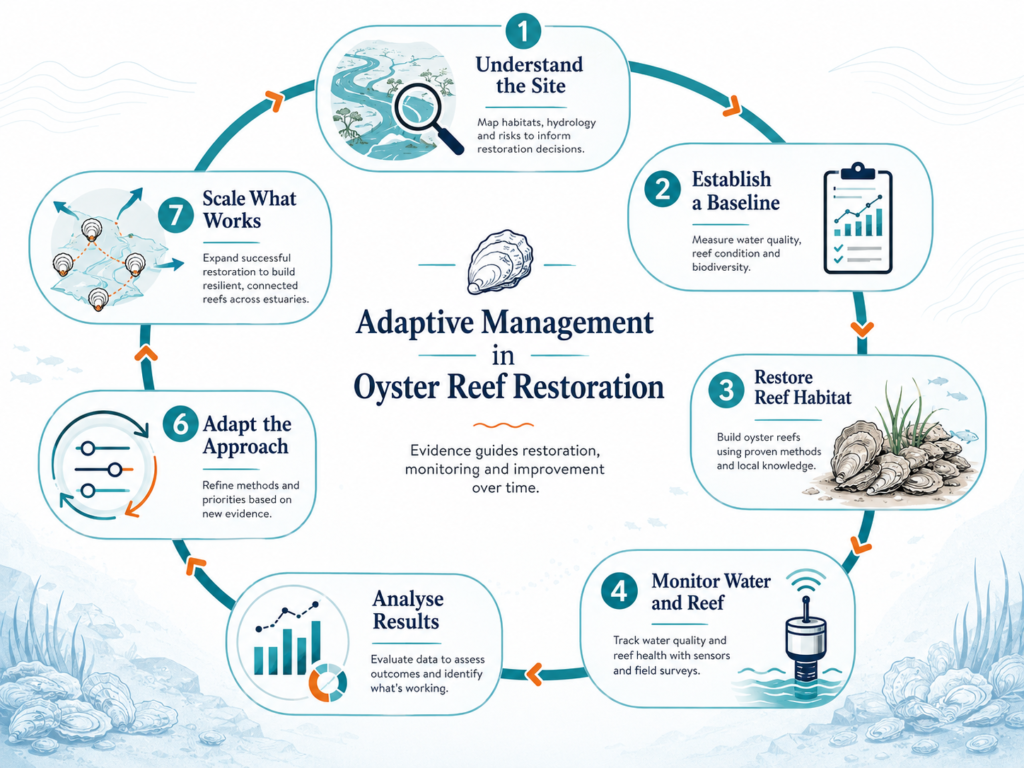
The Nautical Nerds’ approach is intended to be evidence-led and adaptive.
Rather than treating restoration design as fixed, monitoring can be used to compare methods, identify weaknesses and improve subsequent deployments.
A substrate that performs well in one estuary may perform differently in another. A reef height that resists burial at one location may be unnecessary elsewhere.
Oyster stocking density, configuration and restoration materials may therefore require adjustment as field evidence accumulates.
KNOWLEDGE GAPS
Research in Tropical Australia
One of the most important scientific realities surrounding this work is that tropical oyster reefs remain substantially less studied than temperate oyster reefs.
A 2022 review identified major gaps in knowledge about tropical reef distribution, ecology, ecosystem services and restoration.
94
Historical oyster reefs
58
Locations
CENTRAL & FAR NORTH QUEENSLAND
The 2022 review documented historical evidence for at least 94 oyster reefs across 58 locations in central and Far North Queensland.
That historical record is important because it shows that reef-forming oysters were once a significant component of tropical Queensland coastal ecosystems, even though these systems remain much less studied than their temperate counterparts.
Australia more broadly has experienced severe loss of historical shellfish reef ecosystems. A national assessment found dramatic declines in the country’s major reef-forming shellfish habitats following intensive exploitation and other environmental changes during the nineteenth and early twentieth centuries.
Tropical restoration has two jobs: restore what has been lost, and learn what works.
Restore the ecosystem.
Build the evidence.
Carefully designed and independently scrutinised restoration can contribute new evidence about tropical oyster ecology, environmental tolerances, reef design, recruitment, water-quality interactions and long-term ecosystem development.
Restoring tropical oyster reefs can rebuild habitat while also helping close major gaps in our understanding of how these ecosystems function.
OUR EVIDENCE
Research, Monitoring & Transparency
As The Nautical Nerds’ restoration program develops, this page can also become the home of our own scientific results.
Baseline assessments, monitoring methodologies, environmental data, technical reports and independent research findings can be published as they become available.
Where possible, we want to distinguish clearly between:
EVIDENCE
WHAT SCIENCE ALREADY SHOWS
What peer-reviewed research and established scientific evidence already support.
EXPERIENCE
WHAT RESTORATION ELSEWHERE TELLS US
What previous projects suggest may be possible under the right conditions.
LOCAL TESTING
WHAT WE ARE TESTING IN FAR NORTH QUEENSLAND
The questions, methods and restoration approaches being evaluated under local tropical conditions.
OUR RESULTS
WHAT THE DATA ACTUALLY SHOW
What our monitoring reveals as evidence accumulates from restoration sites.
That distinction is central to credible restoration science.
Our objective is not to claim success before it has been measured.
It is to build a restoration program capable of demonstrating it.
SOURCES & FURTHER READING
Research & Evidence
The science and restoration principles discussed on this page draw on peer-reviewed research, Australian monitoring programs and established shellfish restoration guidance.
Rennie et al. (2024)
Filtration rate and bioremediatory potential of the tropical blacklip rock oyster Saccostrea lineage J. Aquaculture Environment Interactions.
Richardson et al. (2022)
Some Like it Hot: The Ecology, Ecosystem Benefits and Restoration Potential of Oyster Reefs in Tropical Waters. Frontiers in Marine Science.
Gillies et al. (2018)
Australian shellfish ecosystems: Past distribution, current status and future direction. PLOS ONE.
Kellogg et al. (2014)
Use of oysters to mitigate eutrophication in coastal waters. Estuarine, Coastal and Shelf Science.
Shellfish as a bioremediation tool: A review and meta-analysis (2022)
Review of shellfish effects on benthic metabolism, nutrients and denitrification.
Australian Institute of Marine Science
Great Barrier Reef water-quality, sediment and nutrient science.
Restoration Guidelines for Shellfish Reefs
Global practitioner guidance developed in alignment with ecological restoration standards.