OYSTER REEF RESTORATION
Rebuilding a Lost Living Ecosystem
Oyster reef restoration is about more than putting oysters back into the water.
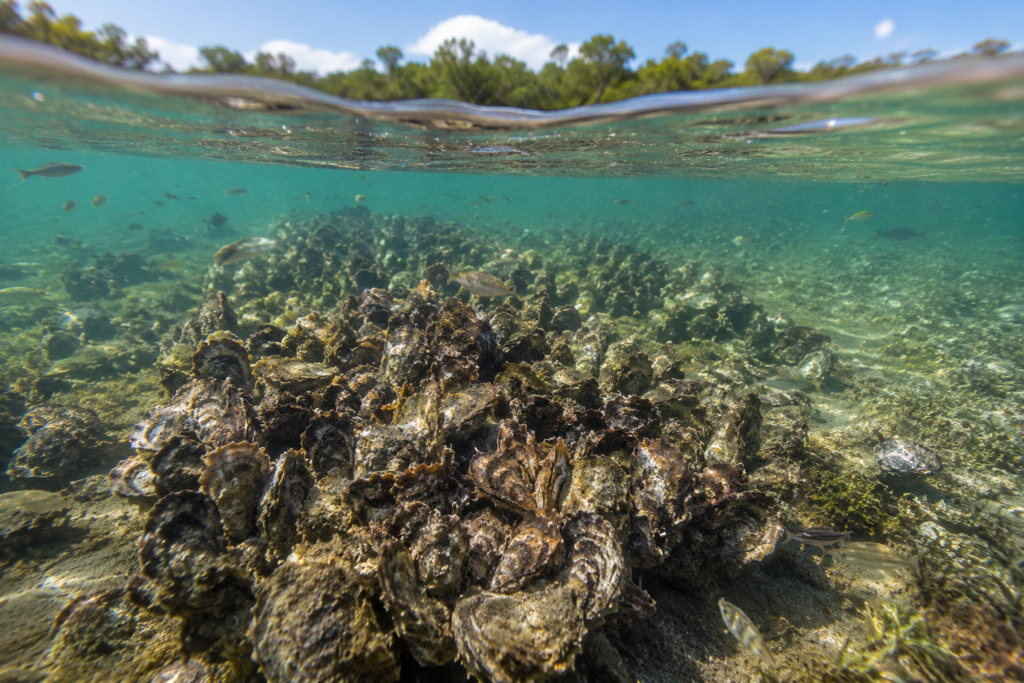
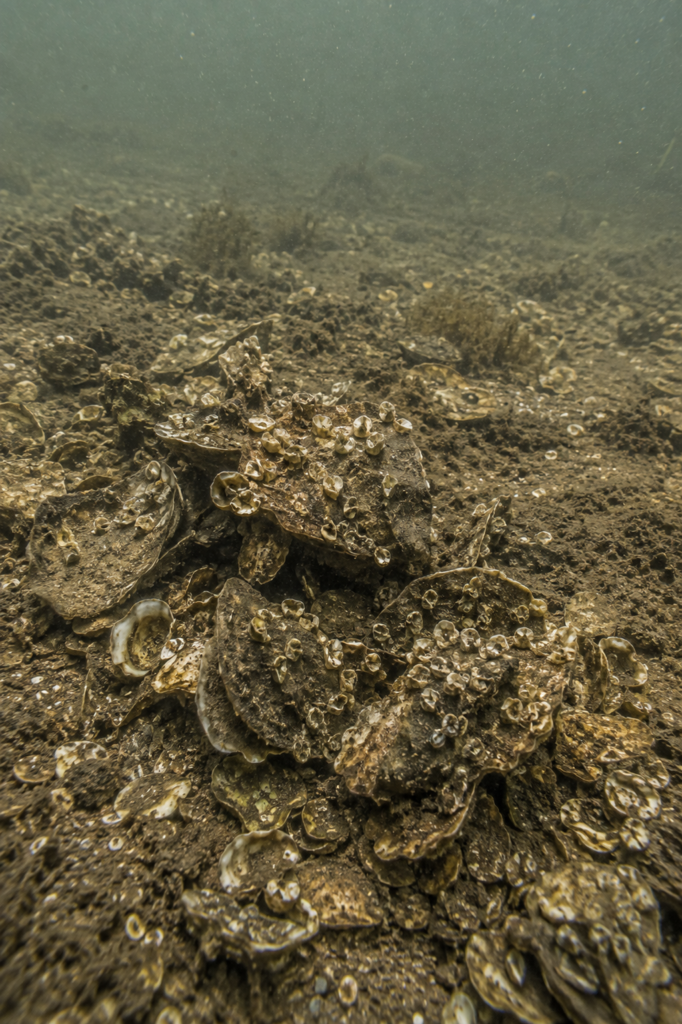
A functioning oyster reef is a living ecosystem built over time as generations of oysters settle, grow and create layers of shell and habitat. These reefs can provide shelter and feeding areas for marine life, interact with sediments and nutrients, and contribute to healthier coastal waterways.
Across Australia, many historic shellfish reefs were heavily degraded or lost following decades of dredging, harvesting, coastal development and other environmental change.
Restoration aims to rebuild the conditions that allow these ecosystems to function again.
For The Nautical Nerds, this means carefully selecting suitable sites, building stable reef foundations, using native oysters and appropriate restoration materials, and continually monitoring how each reef develops. Our long-term goal is to establish healthy oyster reefs that can reproduce naturally and become self-sustaining over time.
PROVEN RESTORATION
Proven elsewhere. Adapted for the Great Barrier Reef.
Oyster reef restoration is already being used successfully in Australia and around the world.
The opportunity in Far North Queensland is to take those established restoration principles and adapt them to local conditions, including tropical oyster species, major river flows, cyclones, heavy sediment loads and waterways connected to the Great Barrier Reef.
We’re not starting from scratch. Our approach is about taking proven restoration principles and applying them carefully to the conditions found in Far North Queensland.
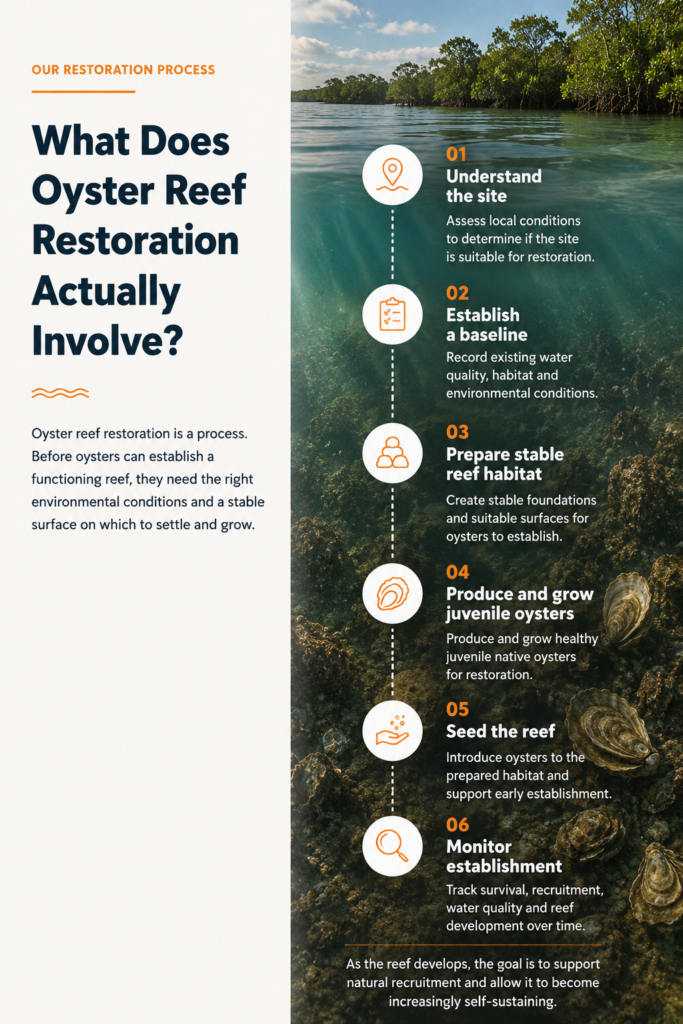
What Does Oyster Reef Restoration Actually Involve?
Oyster reef restoration is a process. Before oysters can establish a functioning reef, they need the right environmental conditions and a stable surface on which to settle and grow.
01 — Finding the Right Place
Site Selection Comes First
Not every estuary, river mouth or section of seabed is suitable for oyster reef restoration.
Before restoration can begin, potential sites need to be assessed for factors such as:
- water depth
- tidal exchange and current velocity
- salinity
- sediment type
- turbidity and sediment movement
- existing marine habitat
- historical oyster presence
- exposure to floods and cyclones
- navigation and boating activity
- accessibility for monitoring and maintenance
Sensitive habitats such as existing seagrass meadows, coral communities and important nursery areas also need to be identified and avoided where necessary.
In tropical Queensland, site selection is particularly important because environmental conditions can change dramatically between the dry and wet seasons.
A location that appears calm in September may experience very different currents, salinity and sediment loads following major summer rainfall.
That is why restoration starts with understanding the system before changing it.
02 — Establishing the Baseline
Knowing What Is There Before Restoration
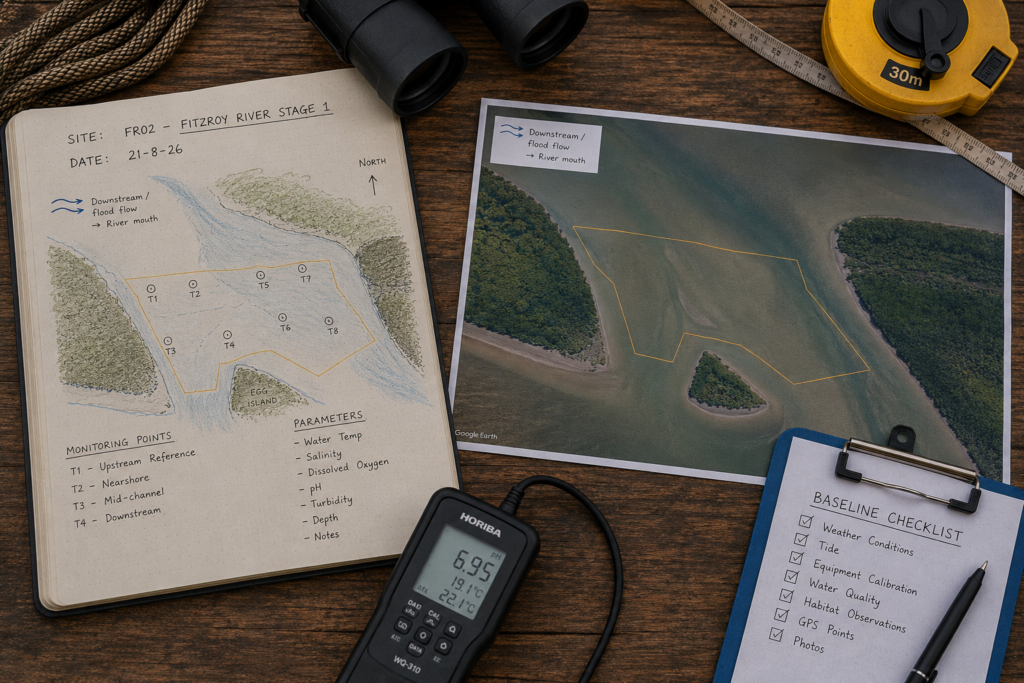
Before assessing whether restoration has made a difference, we first need to understand existing conditions.
Baseline monitoring creates that starting point.
Depending on the site, this may include measurements of water quality, sediment conditions, oyster presence, fish communities, invertebrates, seagrass and other ecological indicators.
Baseline monitoring may examine factors such as:
Temperature
Turbidity
Nutrients
Salinity
Suspended sediment
Water depth
Dissolved oxygen
Chlorophyll
Seabed conditions
Mapping and surveying can also help identify water depth, seabed conditions and the physical characteristics of the proposed restoration area.
This information helps guide project design and later provides something against which restoration results can be compared.
03 — Building the Reef Foundation
Why Oysters Need Something Stable to Grow On
One of the biggest challenges in rebuilding an oyster reef is giving young oysters somewhere stable to live.
For thousands of years, oyster reefs lined river mouths across Far North Queensland. Historical mapping by Richardson et al. (2022) and research by Gillies et al. show that much of this habitat was later lost through dredging and shell harvesting.
Assessments of Australia’s best-documented shellfish reef systems (primarily flat and rock oyster reefs) show losses of 90–99% of historical locations, with many now functionally extinct; data for tropical Blacklip reefs remain far more limited.
Once the old reefs were gone, many areas were left as soft mud or mobile sediment. Juvenile oysters placed directly onto these surfaces can sink, become buried or wash away.
That is why restoration often starts by rebuilding the reef floor first.
Restoration therefore often begins by rebuilding reef foundation habitat.
Depending on site conditions, this may include appropriately selected combinations of:
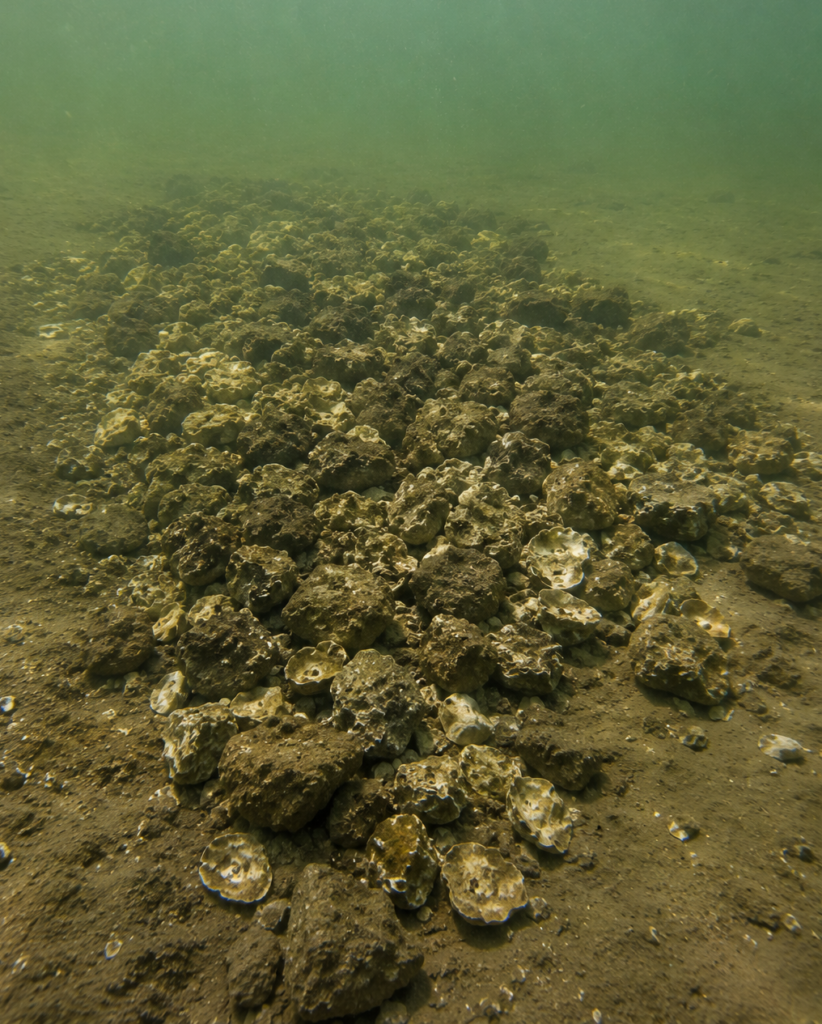
LIMESTONE
ROCK
CURED OYSTER SHELL
GABION CAGES
REEF BALLS
Why the foundation matters
The foundation provides elevation and stability, helping prevent living oysters and settlement surfaces from disappearing into soft sediment. Over time, the aim is for the biological reef growing above the foundation to become the dominant feature.
RESTORATION PRINCIPLE
Why Not Just Dump Oyster Shell Into the Water?
Recycled oyster shell can be an excellent restoration material, but shell by itself is not automatically a reef.
On soft or highly mobile seabeds, loose shell may sink into sediment, become buried or be moved during strong flows.
The effectiveness of shell therefore depends on where and how it is used.
At some locations, shell may be deployed over an established rock or rubble foundation. At others, it may be contained or arranged in configurations designed to maintain elevation and stability.
The key is keeping enough clean, hard settlement surface available for oysters.
Restoration design needs to respond to the seabed beneath it.
04 — Giving Oyster Shell a Second Life
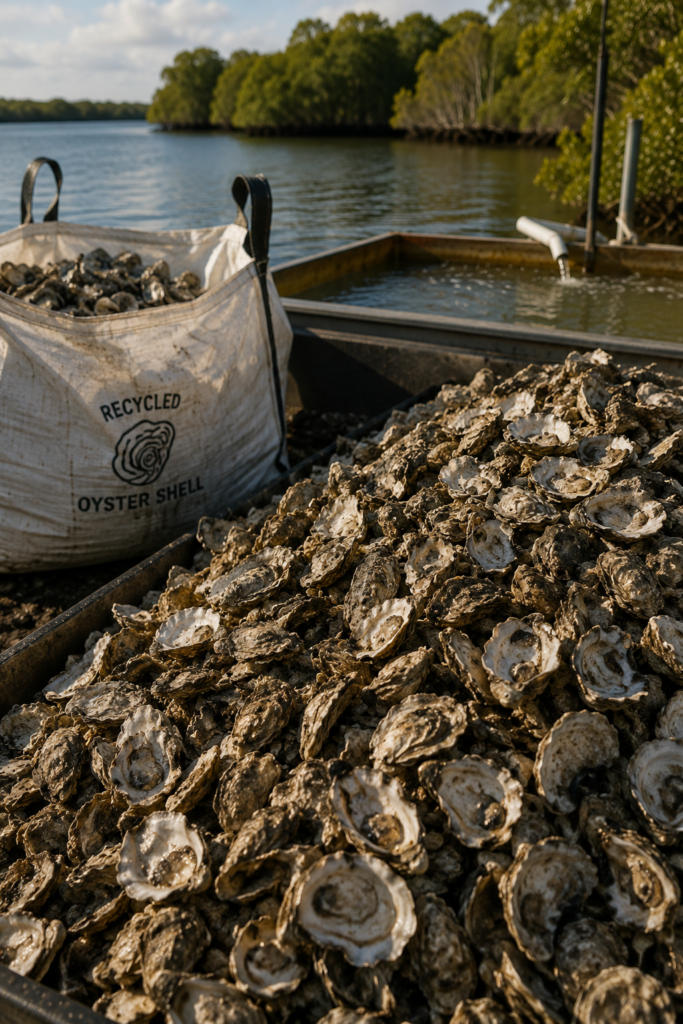
From Waste Material to Reef Habitat
Oyster shell is particularly valuable because it provides exactly the kind of complex hard surface on which oyster larvae naturally settle.
Rather than sending suitable shell to landfill, shell recycling programs can collect material from restaurants, seafood businesses and other sources for future restoration use.
Before being returned to the marine environment, shell needs to be appropriately handled and prepared.
This can involve collection, cleaning, storage and an extended curing period before deployment.
Once prepared, shell can be incorporated into reef restoration in several ways, including as settlement material for naturally recruiting oysters or as a surface carrying hatchery-produced juvenile oysters.
What was once waste can ultimately become part of a new living reef.
05 — Producing the Next Generation
From Broodstock to Spat
Large-scale restoration cannot always rely on enough wild juvenile oysters naturally arriving at a restoration site.
Hatchery production provides another pathway.
Adult oysters selected as broodstock can be conditioned and spawned in controlled facilities.
After fertilisation, oyster larvae spend their early development swimming within the water column.
During this stage they require carefully controlled conditions and microscopic algae for food.
When larvae reach the point at which they are ready to permanently attach, they are provided with suitable settlement surfaces.
Once settled, these tiny juvenile oysters are known as spat.
Spat can then be grown to a more robust size in nursery systems before being transferred into restoration environments.
This allows restoration teams to produce oysters specifically for rebuilding reef habitat rather than relying entirely on uncertain natural recruitment during the earliest stages.
06 — The Nursery Stage
Growing Stronger Oysters Before Reef Deployment
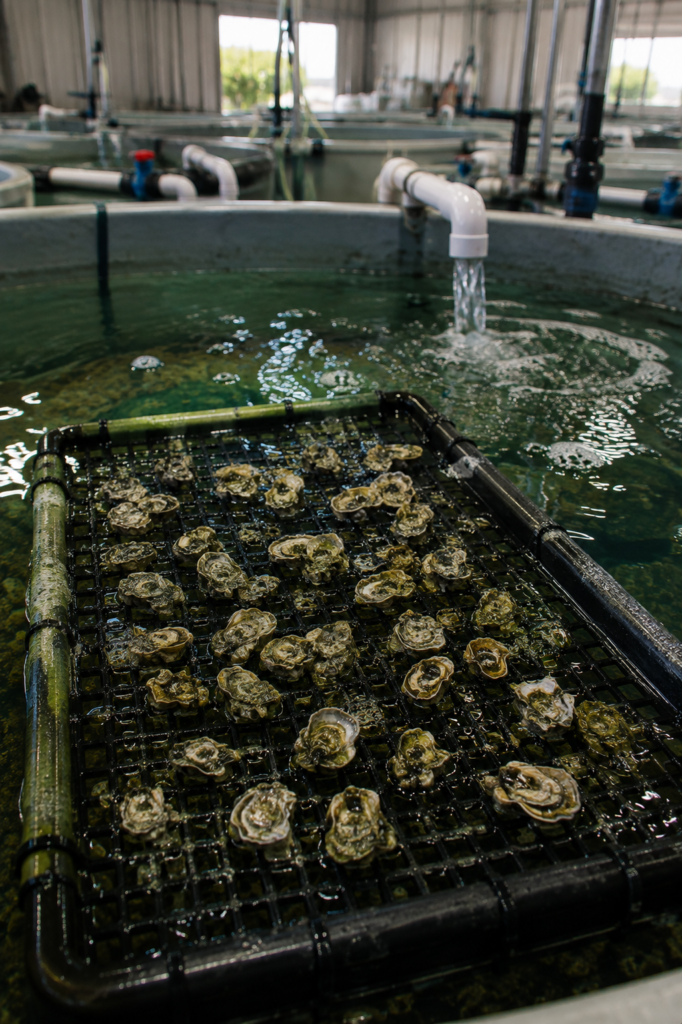
Newly settled spat are extremely small and vulnerable.
Nursery systems allow them to grow through this delicate stage under conditions where water flow, food supply and oyster health can be closely managed.
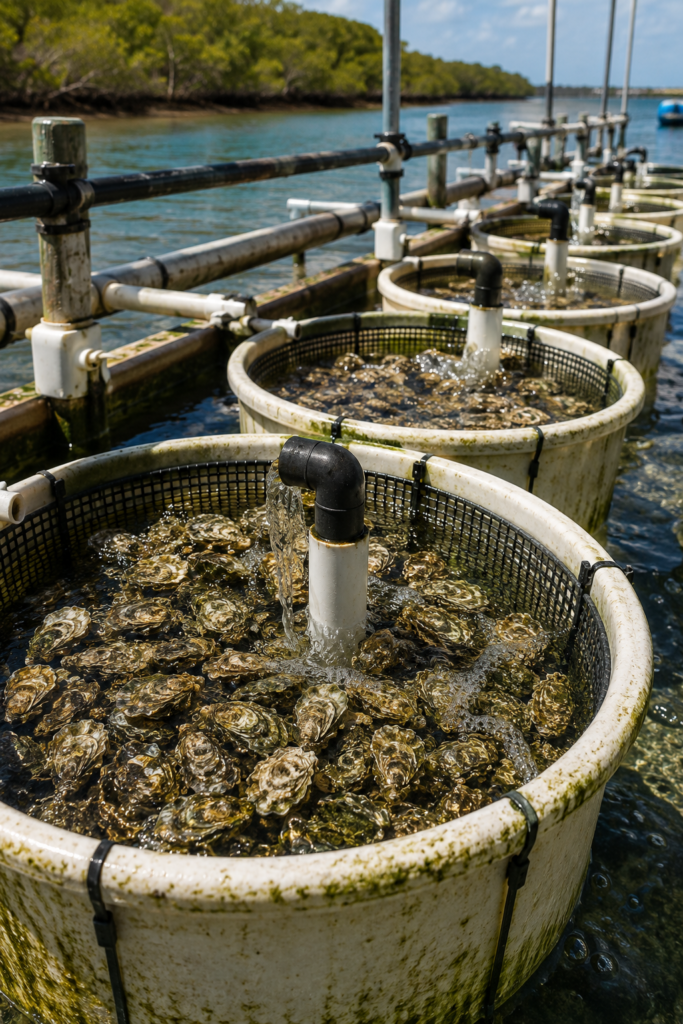
One commonly used technique is an upweller, where flowing seawater carries naturally available food past juvenile oysters while keeping them contained and accessible.
As oysters become larger and stronger, they can progressively move toward field grow-out or reef deployment.
For tropical restoration, this stage can also provide valuable information about growth, survival and environmental tolerance before oysters are committed to permanent reef habitat.
07 — Temporary Grow-Out and Monitoring
Learning Before Permanent Deployment
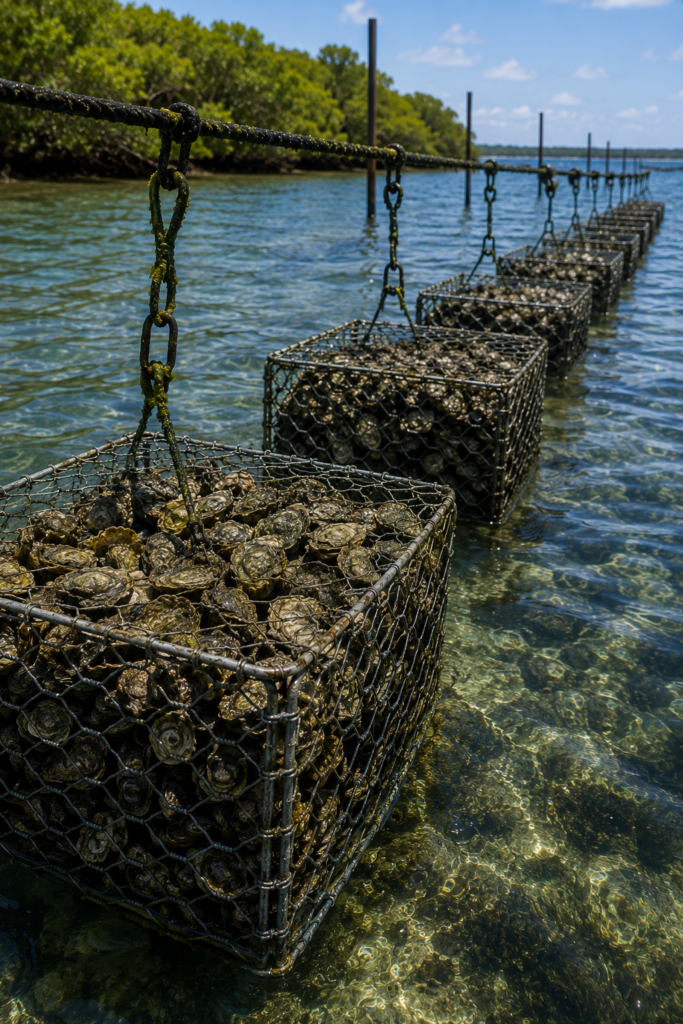
One part of The Nautical Nerds’ planned approach is the use of temporary longline and basket systems for both oyster grow-out and ongoing monitoring.
Juvenile oysters can be held in marine baskets suspended from longlines, where they remain accessible to field crews for regular inspection, measuring and health checks.
This allows the team to track growth, survival, fouling and how oysters respond to changing river conditions, including major floods, wet-season freshwater flows and other environmental events.
These longlines are not simply a holding system while permanent reef habitat is prepared. They also provide a controlled group of oysters that can be monitored alongside oysters already transferred onto restored reef areas, helping the team compare performance and better understand how each site responds over time.
As oysters reach suitable size, they can be transferred onto prepared reef habitat, while the baskets are restocked with new juvenile oysters and reused for continued grow-out and monitoring.
The intention is not to create permanent oyster farms, but to use longlines as practical restoration and research platforms that support the development of healthy, self-sustaining oyster reefs.
All in-water infrastructure remains subject to appropriate assessment, approvals and permits before deployment.
08 — Seeding the Reef
Moving From Infrastructure to Living Habitat
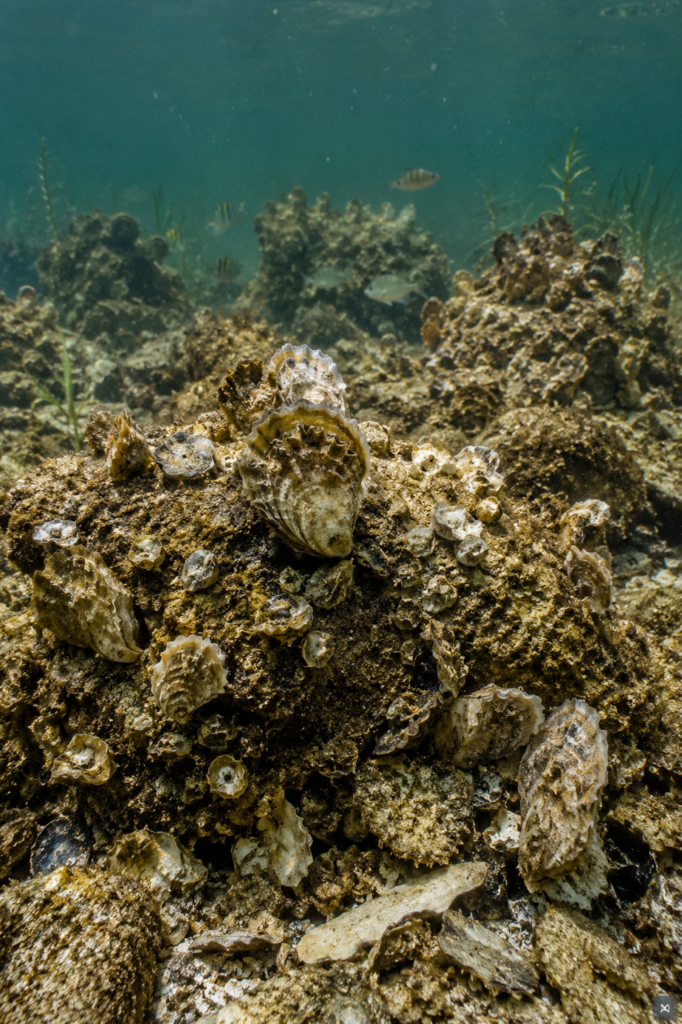
Once suitable foundation habitat has been established and juvenile oysters are ready, biological restoration can begin.
There are several ways oysters can be introduced to restoration substrate.
One approach is spat-on-shell, where juvenile oysters settle onto prepared oyster shell before that shell is deployed onto the reef.
Spat may also be established on other suitable restoration materials.
Larger juvenile oysters grown through nursery or temporary field systems can potentially be transferred into prepared reef areas using methods appropriate to the site.
The goal is to establish enough healthy living oysters across suitable substrate to begin building a reproducing reef population.
From this point, the project increasingly shifts from construction to ecological development.
09 — Engineered Structures: A Supporting Role
Used Where They’re Needed Most
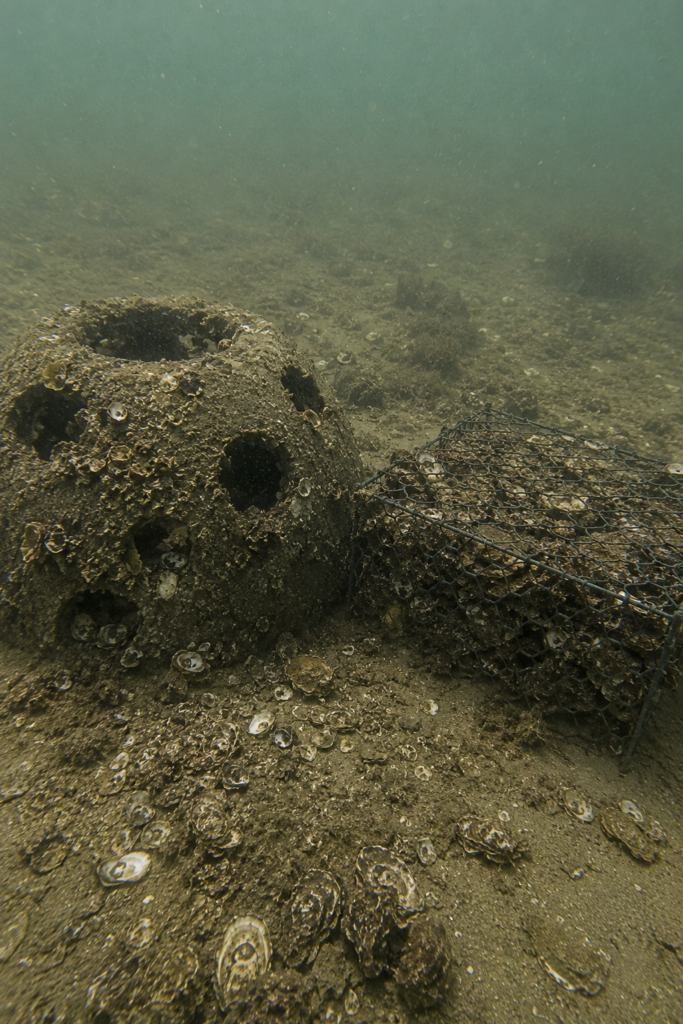
Reef balls, gabion-style structures and other engineered modules can sometimes be useful components of restoration.
But they do not need to make up the entire reef.
Used selectively, structures may provide additional hard surface, protect vulnerable sections of reef foundation, increase habitat complexity or help stabilise restoration material in locations exposed to stronger currents.
In higher-energy environments they may also help break up local flow and reduce movement of shell or rubble.
The majority of a restored reef can still be based around natural or naturalistic materials such as rock, limestone, rubble and oyster shell.
Engineered components are simply another tool available when site conditions justify their use.
10 — Designing for Floods and Cyclones
Restoration in Tropical Queensland Is Different
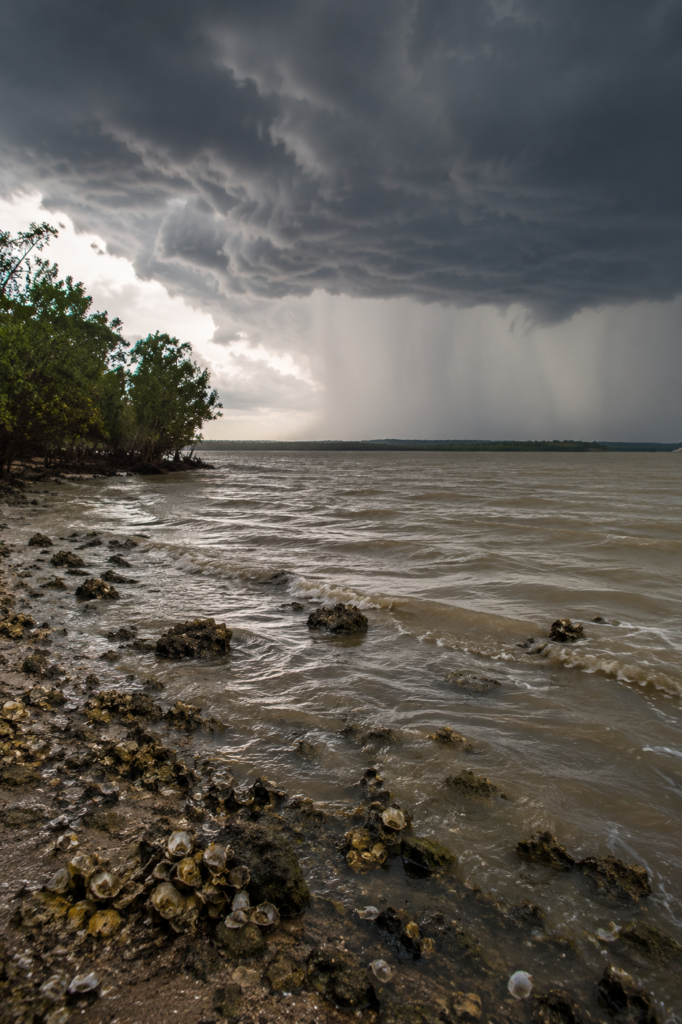
Far North Queensland presents conditions that many oyster restoration projects elsewhere in the world do not have to face.
Tropical river mouths can shift rapidly from normal tidal conditions to cyclones, extreme rainfall, freshwater floods, powerful currents, moving sediments and sudden changes in salinity.
Stable foundations: Able to withstand strong flows and shifting sediment
Resilient materials: Selected to reduce scour and movement
Secure infrastructure: Anchored and monitored through major events
Smart timing: Allowing new restoration areas to stabilise before peak wet season
Restoration here therefore needs to be designed for the extreme events, not just the calm days.
Reef foundations must remain stable, materials must resist scour and movement, and temporary infrastructure must be securely anchored and monitored. Deployment timing can also give newly established areas time to settle before the highest-risk part of the wet season.
A reef that performs well in calm weather but disappears during the first major flood is not successful restoration.
11 — Natural Recruitment
From Restored Reef to Self-Sustaining Reef
Hatchery-produced oysters can help establish a restoration population, but the long-term goal is not to keep manually placing oysters forever.
As adult oysters mature, they spawn and release larvae into the surrounding water. Some of those larvae can settle onto suitable shell and hard reef surfaces, where they grow and add new living structure to the reef.
As more oysters establish, they create additional shell and settlement habitat for future generations.
Adult oysters → spawning → larvae → settlement → growth → more reef structure → more settlement habitat
Over time, this creates a positive ecological cycle in which the reef begins to reproduce, maintain itself and expand naturally.
That is one of the most important milestones in restoration: the point where a reef begins shifting from something people built to something the ecosystem itself is sustaining.
12 — Monitoring the Reef
Restoration Doesn’t End at Deployment
Putting oysters and restoration material into the water is only the beginning.
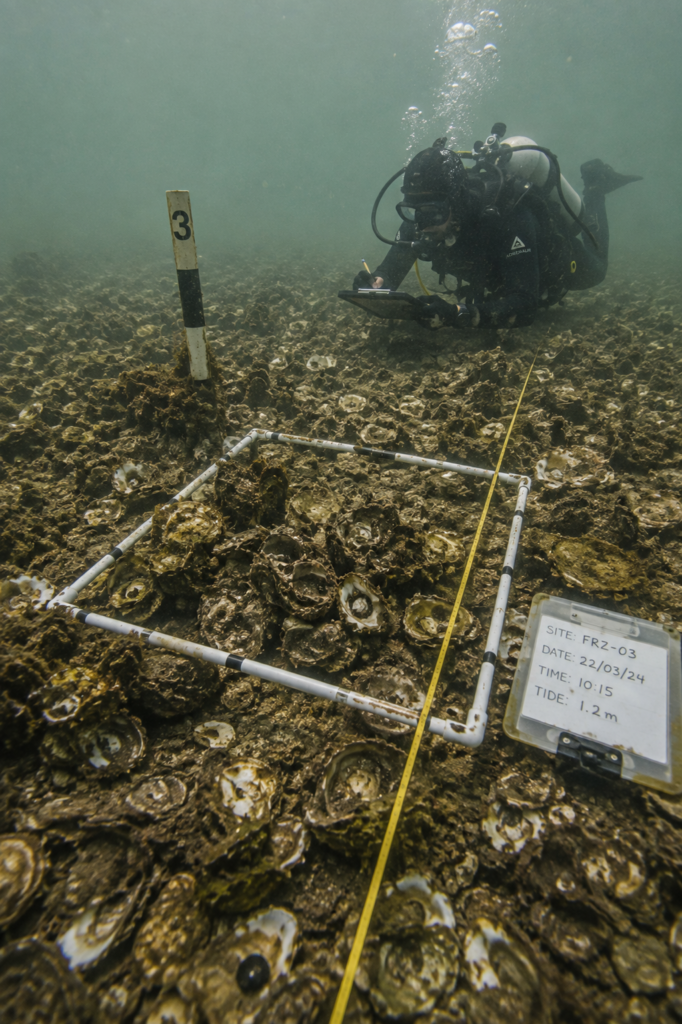
Monitoring helps determine whether the reef is actually developing as intended.
That can include assessing:
- oyster survival and growth
- natural oyster recruitment
- reef footprint and height
- shell and substrate stability
- sediment accumulation and scour
- fish and invertebrate communities
- water quality
- surrounding habitat condition
Remote sensors, field sampling, mapping, photography, drones, sonar or remotely operated underwater vehicles may all have roles depending on the site.
Monitoring is designed to answer practical questions and guide restoration decisions.
Are the oysters surviving?
Is the reef staying in place?
Are young oysters naturally recruiting?
Is biodiversity changing?
Are there any unintended impacts?
Should the restoration design be changed?
13 — Learn, Adapt and Improve
No two river systems are identical.
A restoration technique that performs extremely well in one location may require modification somewhere else.
That is why The Nautical Nerds intends to use adaptive management.
Early restoration sites can help identify which substrate configurations, oyster densities, grow-out methods and monitoring techniques perform best under tropical Queensland conditions.
If something is not working, the goal is not to keep repeating it.
It is to understand why, adjust the approach and test the improvement.
Start carefully. Measure the results. Learn what works. Then scale what works.
That principle is already central to the restoration pathway across our broader work.
What Does a Successful Oyster Reef Look Like?
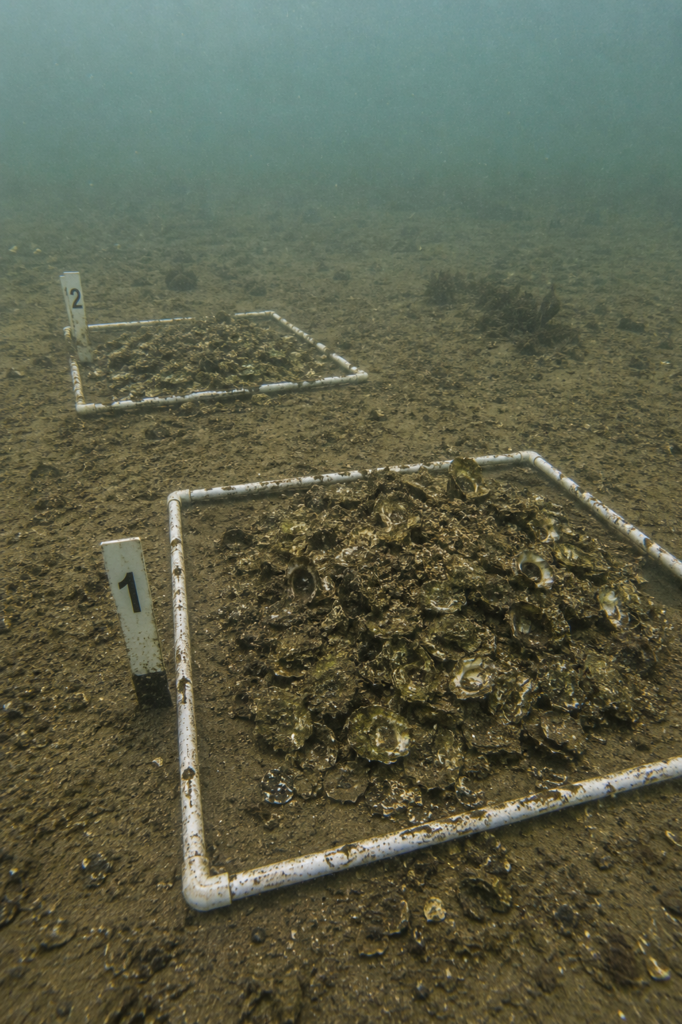
Success is not simply reaching a target number of oysters.
A restored reef should gradually begin behaving more like a natural ecosystem, surviving, reproducing, building structure and supporting other marine life.
✓
Strong Oyster Survival
Oysters survive, grow and remain established.
✓
Natural Recruitment
New oysters begin settling without continual restocking.
✓
Stable Reef Structure
The reef remains in place and resists erosion or burial.
✓
Growing Reef Layers
Shell and living oyster layers gradually build.
✓
Increasing Biodiversity
More fish, crabs, prawns and invertebrates use the reef.
✓
Less Human Intervention
The reef increasingly maintains and expands itself naturally.
The long-term goal is simple:
A self-sustaining reef that can maintain and expand itself.
Human intervention starts the process. Nature increasingly takes over from there.
Oyster Reef Restoration Around the World
Across Australia and internationally, oyster reef restoration projects are showing that lost shellfish reefs can be rebuilt. Methods vary between species, climates and locations, but successful projects provide valuable lessons in reef construction, oyster recruitment, biodiversity recovery and long-term monitoring.
Australia
Australia has become increasingly active in shellfish reef restoration, with major projects now underway across several states.
These projects provide valuable local experience in reef construction, oyster recruitment, habitat recovery and long-term monitoring.
South Australia
Windara Reef
Built near Ardrossan in Gulf St Vincent, Windara Reef restored approximately 20 hectares of lost shellfish reef habitat using limestone reef foundations seeded with Australian Flat Oysters.
More than seven million oysters were seeded across the reef, with monitoring since recording oyster survival, natural recruitment and a growing diversity of marine life.
Victoria
Port Phillip Bay
Shellfish reef restoration began in Port Phillip Bay with experimental trials in 2015, followed by the restoration of Australia’s first shellfish reefs in the bay in 2017.
Restoration has since expanded across several locations, using locally sourced limestone, recycled shell and millions of native Australian Flat Oysters and Blue Mussels to rebuild lost reef habitat. Monitoring has recorded developing reef communities supporting a growing range of fish and invertebrates.
QUEENSLAND
Noosa Oyster Restoration
The Noosa Oyster Ecosystem Restoration Project is rebuilding oyster reef habitat within the Noosa River system, where oyster reefs were once far more extensive before being heavily depleted.
The project uses purpose-built reef structures to create stable habitat for oysters to establish naturally. Monitoring is helping researchers understand oyster recruitment, fish communities and how restored reefs can contribute to the health of the Noosa River.
International
Projects around the world show how oyster reef restoration can be adapted to very different coastlines, species and environmental conditions.
These examples offer useful lessons in large-scale reef construction, community involvement and long-term ecosystem recovery.
UNITED STATES
Chesapeake Bay, United States
The Chesapeake Bay is home to one of the world’s largest and longest-running oyster restoration efforts.
After severe historical declines in oyster populations and reef habitat, major restoration programs have rebuilt reefs, planted juvenile oysters and established protected restoration areas across multiple tributaries.
The program has become an important international example of what can be achieved when oyster restoration is undertaken at large scale and monitored over long periods.
UNITED STATES
New York Harbor
The Billion Oyster Project is working toward restoring a massive oyster population to New York Harbor.
Alongside reef restoration, the program involves schools, researchers and community volunteers and has helped demonstrate how oyster restoration can be combined with education, citizen science and large-scale public involvement.
UNITED KINGDOM
Solent Oyster Restoration
The Solent was once home to Europe’s largest native oyster fishery, but oyster populations declined dramatically following pressures including overfishing, disease, pollution and habitat loss.
Since 2015, restoration efforts have used oyster nurseries, reef construction and hatchery-supported production to rebuild native oyster populations. New reefs are now being established across the Solent, supported by scientific monitoring and community involvement.
LESSONS FROM ELSEWHERE
Different Places, Same Principle
These projects do not provide a ready-made blueprint for Far North Queensland.
Temperate oyster reefs in southern Australia, North America and Europe experience different temperatures, species, hydrodynamics, rainfall patterns and extreme-weather conditions from tropical Queensland river systems.
Oyster reef ecosystems can be actively restored.
The task for tropical Queensland is to take the lessons learned elsewhere, combine them with local science and native Blacklip Rock Oyster biology, and determine which restoration methods perform best under our own conditions.
How It All Works Together
Our restoration model combines several complementary methods rather than relying on one technique alone. Site conditions, monitoring and oyster performance determine which combination is used.
RECYCLED SHELL
Creates clean, hard settlement surfaces for young oysters to attach and grow.
STABLE FOUNDATION
Rock, rubble and limestone create a durable base that keeps reef material elevated and in place.
ENGINEERED STRUCTURES
Reef balls and gabion cages add stability, reduce scour and create habitat complexity where needed.
Monitoring then determines which combinations perform best under local conditions.
From active restoration to self-sustaining living reefs.
The long-term aim is for oyster populations to reproduce, expand and maintain the reef with progressively less human intervention.
Where We Are Now
Oyster reef restoration in sensitive marine environments requires careful planning.
The Nautical Nerds is progressing through the scientific, environmental, cultural and regulatory work needed before major in-water restoration can begin.
Site visits and early investigations are underway to assess seabed conditions, water depths and potential restoration areas. Permit applications for these areas are also progressing.
This work supports project design, monitoring plans and engagement with relevant authorities, specialists, Traditional Owners and other stakeholders.
Specific sites and deployment methods may change as assessments, consultation and approvals progress.
Understand the environment first. Build carefully. Measure what happens. Then expand based on evidence.
Want to Understand the Science Behind It?
This page explains how oyster reef restoration is carried out. Explore the science behind why it works, or start with the fundamentals.
Go Deeper Into the Science
SCIENCE & RESEARCH
Explore oyster filtration, nutrient cycling, denitrification, sediment dynamics, hydrodynamics and the science used to understand how restored oyster reefs function.
Start With the Fundamentals
EDUCATIONAL RESOURCES
Learn the basics of oyster biology, reef ecosystems, water quality and restoration terminology through clear, accessible educational resources.